
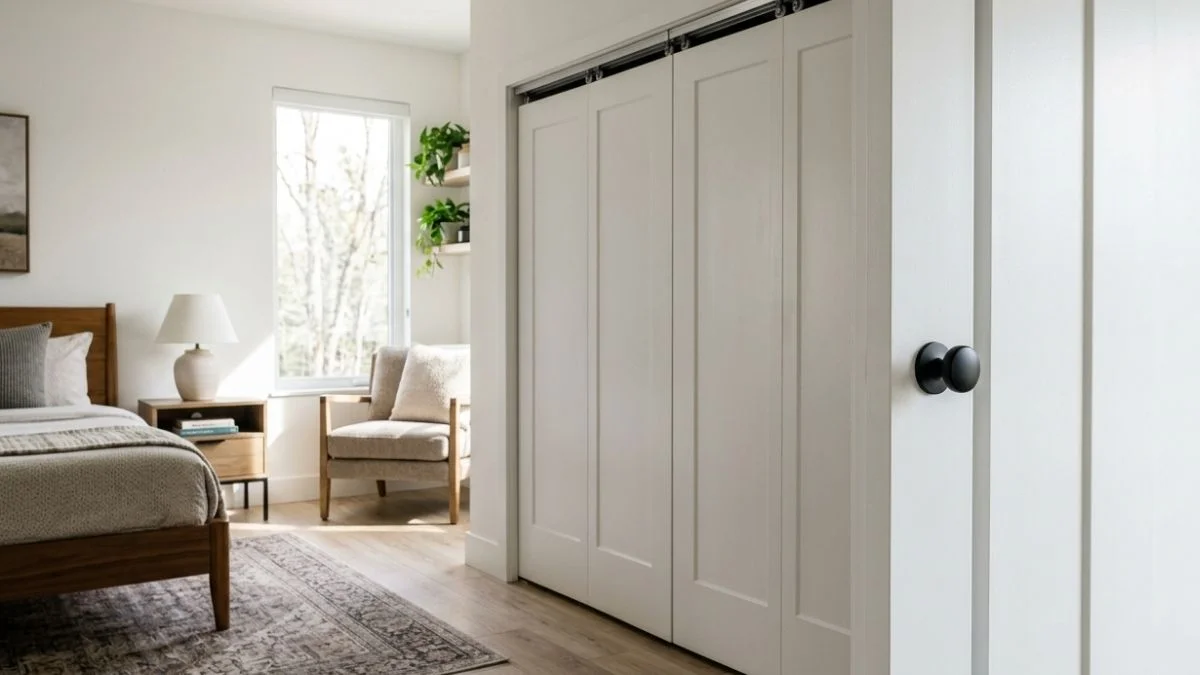
Yes, you can use cabinet knobs on bifold doors — most standard cabinet knobs mount with a single 8-32 machine screw, the same fastener spec used on bifold door pulls sold at Home Depot and Lowe’s.
The real problem is that most DIY homeowners assume bifold doors require specialty hardware, so they buy replacements instead of checking what they already own.
Read this guide and you will know exactly which knobs work, where to place them, and how to install them without mistakes.
How Bifold Door Hardware Actually Works
Bifold Mechanics and Why Traditional Knobs Aren’t Needed
A bifold door runs on a track-and-pivot system, not swing hinges. The top track guides a roller, and pivot pins at the top and bottom corners anchor each panel. The door folds in on itself when you pull it open — no latch, no strike plate, no latching mechanism of any kind.
This is the key distinction. A standard interior swing door needs a functioning knob to release a latch bolt. A bifold panel has nothing to release. The hardware you attach to a bifold door is purely there so you have something to grip when pulling the panel open or closed.
Functional vs. Decorative Hardware Distinction
Cabinet knobs are engineered to pair with a latch mechanism — the spindle or screw connects the knob to a latch body inside the door. On a bifold panel, that latch body doesn’t exist. You’re only mounting the knob to give your hand a pull point.
This is exactly what the hardware industry calls “dummy hardware.” Dummy knobs for bifold doors are non-turning, non-latching pulls that mount flush to the door face with a single screw. Cabinet knobs work the same way when installed on a bifold panel — the screw goes through the door face, a nut or threaded insert locks it from behind, and you’re done.
The practical result: closet door knobs, cabinet pulls, and dedicated bifold door handles are all functionally equivalent on a bifold panel. What differs is appearance, projection length, and screw compatibility — all of which are easy to verify before you buy or repurpose anything.
Cabinet Knobs vs. Bifold-Specific Hardware
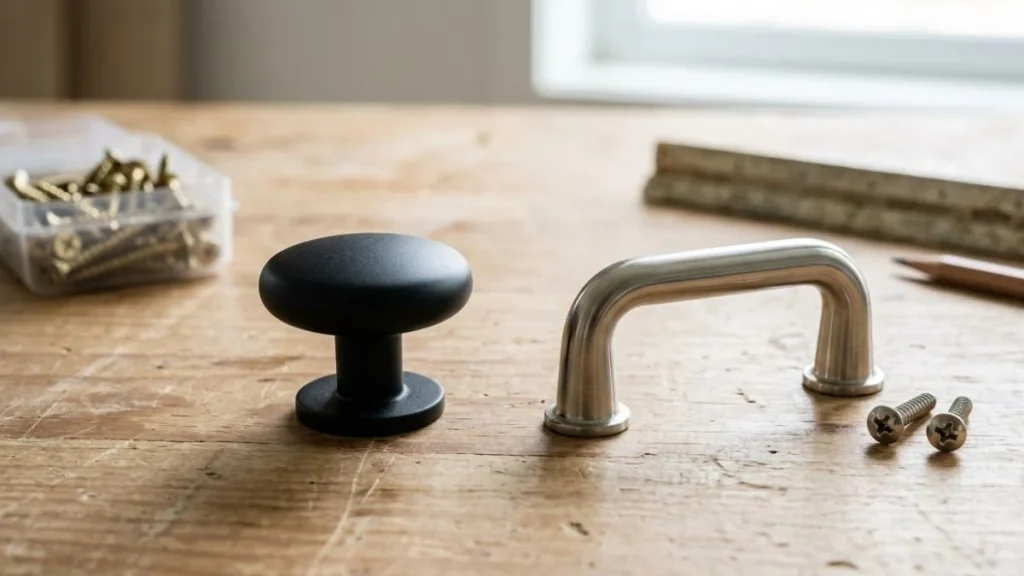
The differences between cabinet knobs and bifold-specific pulls come down to 3 measurable factors: hole diameter, screw size, and projection depth. Get these right and any cabinet knob becomes viable bifold door hardware.
Hole Diameter and Screw Compatibility
Most cabinet knobs use a single mounting hole drilled at 3/8 inch diameter, accepting an 8-32 machine screw. Bifold-specific hardware from brands like Liberty Hardware and Amerock uses the exact same spec. This means the mounting holes are interchangeable — a cabinet knob drops straight into the same hole a bifold pull would occupy.
Where you can run into trouble is with oversized decorative cabinet knobs that ship with a 10-32 screw instead of 8-32. Check the packaging before repurposing any knob.
Projection Depth and Usability
Projection depth is how far the knob extends from the door face. Cabinet knobs typically project 1 to 1.5 inches. Bifold-specific pulls often project 1.25 to 2 inches because bifold panels sit inside a door frame opening — you need enough clearance to get a finger grip without knuckling against the door jamb.
A knob with less than 1 inch of projection works fine on a cabinet drawer but feels awkward on a bifold closet panel.
Quick Compatibility Checklist
Before mounting any cabinet knob on a bifold panel, confirm these 4 things:
- Screw size matches: 8-32 is the standard
- Knob projects at least 1 inch from the door face
- Door panel thickness is 1.375 inches (standard hollow-core bifold) or adjust screw length accordingly
- Backplate diameter, if present, fits within the panel stile width without overlapping the fold line
Knobs from Amerock’s Allison Value Hardware line, Liberty’s Contempo series, and even basic round cabinet knobs from the Lowe’s house brand all meet these specs and install cleanly on standard bifold panels.
Installation and Placement for Bifold Doors
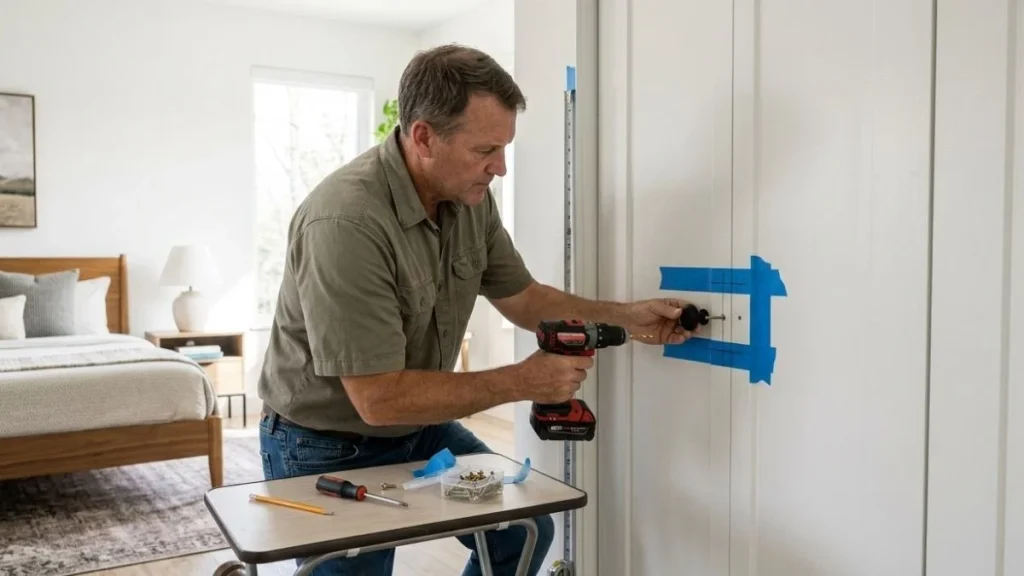
Where Knobs Go on Bifold Panels
Mount the knob on the leading panel only — that’s the outer panel that faces you when the door is closed, on the edge closest to the door jamb. The trailing panel folds behind it and has no practical grip point during normal operation.
Standard bifold door knob placement puts the knob 36 inches from the floor on residential closet doors, matching ADA-compliant reach range guidelines. Horizontally, position the knob 2 to 3 inches in from the leading edge of the panel. Any closer to the edge and the knob sits on thin stile material that can split under repeated pulling force.
On a double bifold configuration — two sets of panels meeting at the center — mount one knob on each leading panel, mirrored at the same height.
Step-by-Step Installation Without Damage
Tools needed: power drill, 3/8-inch brad-point bit, screwdriver, painter’s tape, and a ruler.
Follow these steps in order:
- Mark the knob position with painter’s tape — it prevents drill bit wander on smooth door surfaces.
- Drill from the front face only, at low speed, to avoid blowout on the back veneer.
- Thread the 8-32 machine screw through the knob, then through the hole, and hand-tighten a nut or the knob’s included barrel nut on the back face.
- Tighten with a screwdriver — do not overtighten on hollow-core panels, which compress and crack under excessive torque.
If the door has an existing pre-drilled hole that’s too large for your knob’s screw, fill it with a wooden toothpick and wood glue, let it cure fully, then redrill at the correct diameter. Screw hole adapters — available at Rockler Woodworking and hardware stores — also work for upsizing or downsizing mounting hardware without filling.
You May Like Also: Cabinet Pulling Away?
Frequently Asked Questions
Can I Use Regular Cabinet Knobs on Bifold Doors?
Yes. Standard cabinet knobs mount with an 8-32 machine screw through a 3/8-inch hole — the same spec used by bifold-specific hardware from brands like Liberty Hardware and Amerock. As long as the knob projects at least 1 inch from the door face and the screw length matches your panel thickness, any cabinet knob works.
What Is the Difference Between Dummy Knobs and Functional Knobs?
Dummy knobs are non-turning, non-latching pulls that mount to a door face with a single screw — no spindle, no latch mechanism. Functional knobs connect to a latch bolt through a spindle and are designed for swing doors. Bifold doors never need functional knobs because they operate on a track-and-pivot system with nothing to latch.
How Far From the Edge Should Bifold Door Knobs Be Placed?
Place the knob 2 to 3 inches in from the leading edge of the panel — the edge closest to the door jamb. Mounting closer than 2 inches puts the screw in thin stile material that can split. Vertically, the standard residential placement is 36 inches from the floor.
Making Your Final Hardware Choice
Cabinet knobs and bifold door hardware are functionally identical on a bifold panel — the only thing that matters is an 8-32 screw, a 3/8-inch hole, and at least 1 inch of projection. Pull out any cabinet knob you already own, confirm those three specs against your door panel thickness, and install it today using the four-step process in this guide.