

Floors in homes built between the 1940s and 1960s were almost universally finished with paste wax — not polyurethane — and knowing how to clean a waxed wood floor correctly is the difference between restoring their original luster and stripping decades of protective finish.
The real problem most homeowners face is uncertainty: modern floor cleaners, steam mops, and water-based products can dissolve or cloud wax finishes, and one wrong product can undo 50 years of careful preservation.
This guide gives you a clear, step-by-step cleaning method that removes dirt and buildup safely, using products and techniques that work with wax rather than against it.
Daily and Weekly Cleaning Routine
Dry cleaning is the foundation of vintage wood floor care. Water is wax’s worst enemy — even small amounts can penetrate the finish, raise the wood grain, and leave permanent white water marks. Keep moisture off waxed hardwood floors entirely during routine maintenance.
Choosing Equipment for Waxed Surfaces
Not all floor tools protect wax finishes equally.
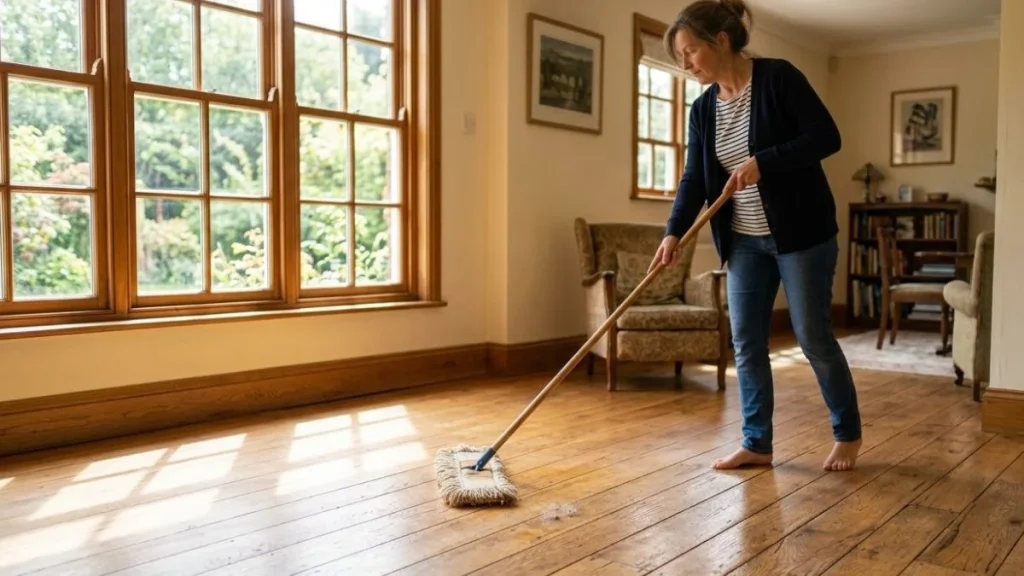
A wool dust mop is the gold standard for hardwood floor maintenance. Wool’s natural lanolin attracts and holds dust electrostatically without scratching, and it glides over wax without pulling or scuffing the finish. Microfiber mops are a reasonable alternative, but some microfiber pads create enough friction on a waxed surface to dull the sheen over time — use the flat, non-scrubbing variety only.
For vacuuming, always switch to the hardwood or bare-floor setting, which disengages the beater bar. A spinning beater bar on a waxed floor acts like a buffer running in reverse — it scuffs and dulls the finish with every pass.
Electrostatic dry cloths, like those from Swiffer’s dry line, also work well for quick daily passes. The electrostatic charge grips fine dust and pet hair without any liquid contact, making them a practical tool for floor finish protection between weekly moppings.
Spot Cleaning Spills Immediately
Speed matters more than technique here — but technique still matters.
Blot spills with a clean, dry cloth. Never wipe across the grain, which pushes liquid deeper into the wood pores. Work from the outside edge of the spill inward. For sticky residue, a cloth barely dampened with plain water — wrung until almost dry — is the maximum moisture a waxed surface should ever see during spot cleaning.
Safe Wet Cleaning Methods for Waxed Floors
Wet mopping and waxed hardwood floors are fundamentally incompatible. When gentle cleaning methods for waxed wood are necessary — for ground-in grime or sticky residue that dry methods can’t lift — the damp cloth technique is the only safe approach.
Proper Moisture Levels and Application
“Barely damp” is a precise standard, not a loose guideline. Wring your cloth or mop pad until no water drips when squeezed firmly, then wring it once more. The cloth should feel cool and slightly moist against your palm — nothing more.
Before cleaning any visible area, test your method on an inconspicuous spot, such as inside a closet or behind a door. Wait 60 seconds and check for cloudiness, whitening, or any change in sheen. If the finish shifts at all, go drier.
Steam mops are never safe on waxed floors. The heat and pressurized moisture penetrate directly into the wax layer, emulsifying it and driving water into the wood beneath. A single pass can cause clouding, cupping, or irreversible finish damage on a historic floor.
Recommended Cleaners and DIY Alternatives
Bona Hard-Surface Floor Cleaner is pH-neutral and residue-free, making it one of the safer commercial options for damp-cloth cleaning on waxed surfaces. Apply it to the cloth, never directly to the floor.
A 1:10 vinegar-to-water ratio works as a budget alternative for light cleaning. Use it sparingly — vinegar’s mild acidity can dull wax with repeated use over months.
Here’s what to avoid entirely: Murphy’s Oil Soap leaves a soap film that traps dirt and builds up on the wax layer. Dawn dish soap is a degreaser by design — it actively strips wax from the surface, functioning more like a commercial wax stripper than a floor cleaner.
Removing Wax Buildup and Buildup Signs
Three signs tell you wax buildup has become a problem: the floor looks dull even after cleaning, it feels slightly tacky underfoot, or it has developed a yellowish cast in high-traffic areas. These symptoms mean old wax layers have accumulated faster than they’ve worn away, and routine cleaning won’t fix it — you need wax removal techniques that dissolve the finish itself.
Mineral Spirits Application Process
Mineral spirits — also called paint thinner or petroleum spirits — works on wax through simple chemistry. Wax is a non-polar substance, and mineral spirits is a non-polar solvent, meaning it dissolves wax on contact without damaging the wood fiber beneath. Water, by contrast, is polar and cannot dissolve wax at all, which is why wet mopping never removes buildup.
Ventilation is non-negotiable. Open all windows, run a fan pointed outward, and keep ignition sources — pilot lights, space heaters — off. Mineral spirits is flammable and produces vapors that accumulate at floor level.
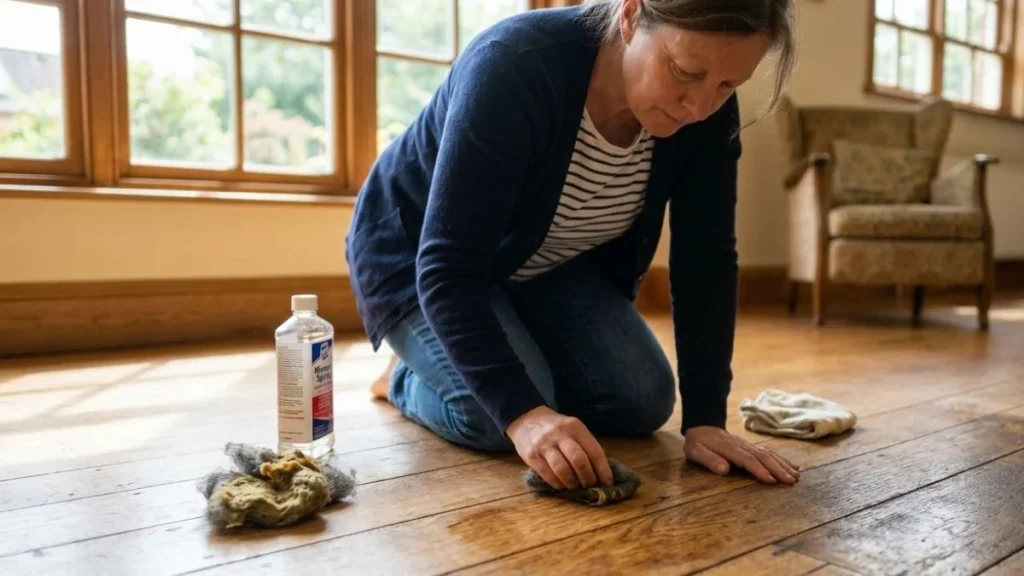
Apply mineral spirits to a fine steel wool pad (grade #000) or a clean white cloth. Work in 2-foot sections, rubbing gently with the grain. The pad will turn yellow-brown as it lifts dissolved wax. Switch to a clean pad frequently to avoid redistributing buildup rather than removing it. Never pour mineral spirits directly onto the floor — over-saturation can raise the grain and weaken old adhesives in plank floors.
Commercial Wax Strippers vs. Natural Alternatives
For light buildup, the 1:10 vinegar solution described in the previous section can soften and lift thin wax layers. It works slowly and requires multiple passes, but it costs under $1 per application and carries no fume risk.
Commercial wax strippers like Holloway House Quick Shine Floor Finish Remover or Bruce Hardwood Floor Cleaner are formulated specifically for wax buildup removal on hardwood. They work faster than mineral spirits on heavy accumulation and are safer for homeowners uncomfortable handling petroleum solvents — expect to pay $8–$15 per bottle covering roughly 200–300 square feet.
When buildup is severe — multiple unstripped layers spanning decades — DIY methods become insufficient. At that point, a professional flooring contractor with a floor buffing machine and industrial-strength commercial wax stripper is the right call. Attempting to strip that volume manually risks uneven removal and exposes raw wood in high-friction areas.
You May Read Also: Repairing Bruce Hardwood Floors
Preserving Original Finishes for the Long Term
The single most effective thing you can do for a waxed hardwood floor is keep moisture and the wrong products away from it consistently — daily dry mopping with a wool dust mop, monthly damp-cloth touch-ups with a pH-neutral cleaner, and a mineral spirits buildup removal once every 1–2 years will keep an original finish intact for decades without professional intervention.
Start today by inspecting one inconspicuous section of your floor for the three buildup signs — dullness, tackiness, and yellowing — to determine whether you need routine maintenance or a full wax removal first.