
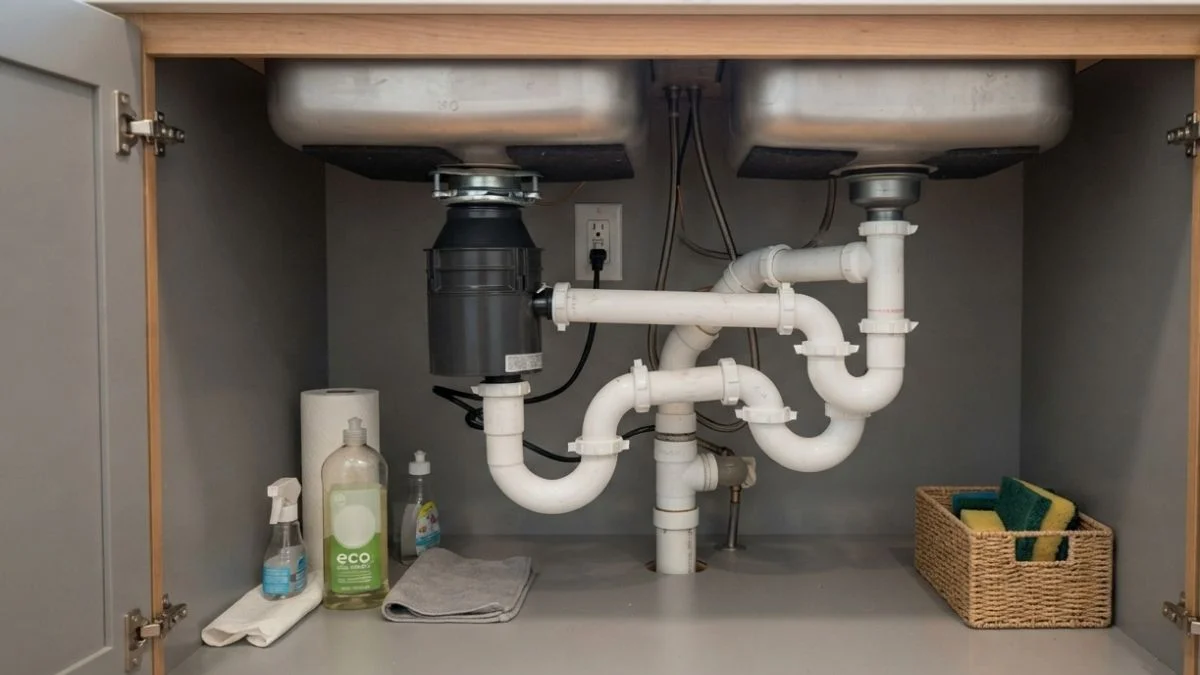
If you’ve ever peeked under your kitchen sink and noticed the drain pipes forming what looks like two connected curves — almost like an “S” or a double loop — you’re not alone. Many homeowners discover this setup during a DIY project, a bathroom renovation, or a home inspection and immediately wonder: is this normal? Is it safe? And most importantly, is it against plumbing code?
The short answer is yes — a double P trap under a kitchen sink is a plumbing code violation in most parts of the United States. But understanding why it’s a problem, and what you can do to fix it, is what really matters. This article breaks it all down in plain language so you can take action with confidence.
What Is a P Trap and Why Does Your Kitchen Sink Need One?
Before getting into the double trap issue, it helps to understand what a P trap actually does and why it exists in the first place.
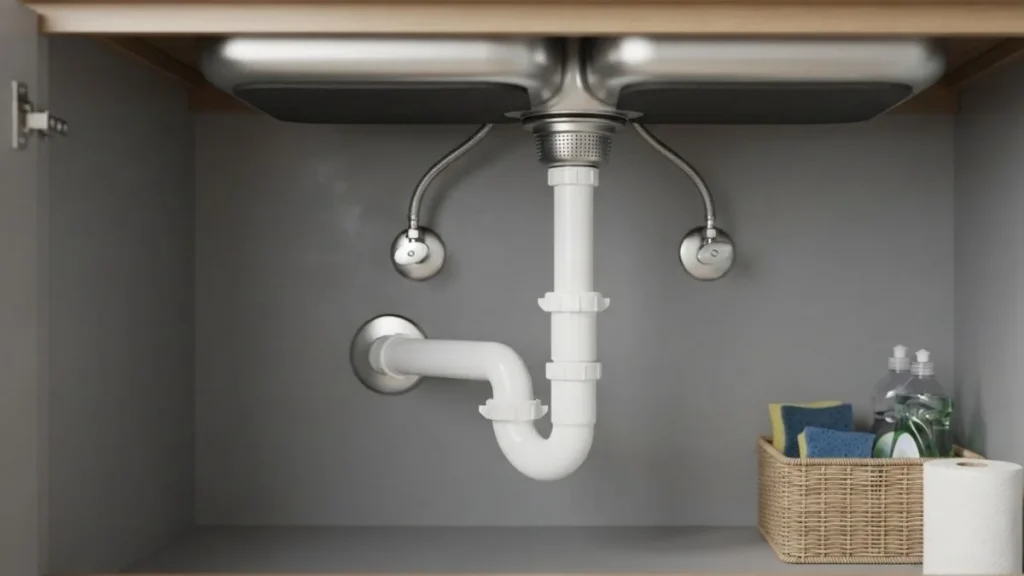
A P trap is the curved pipe section located directly beneath your kitchen sink drain. It gets its name from its shape — when viewed from the side, it resembles the letter “P.” This simple design serves a very important purpose: it holds a small amount of water at all times, which acts as a seal against sewer gases. Without that water seal, toxic gases like hydrogen sulfide and methane could travel up through your drain and into your kitchen.
How a P Trap Works
Every time water flows down your sink drain, it passes through the P trap. A portion of that water remains trapped in the curved section after the flow stops. This standing water creates a barrier that sewer gases simply cannot pass through under normal conditions. It’s a passive, maintenance-free safety mechanism that has been standard in residential plumbing for well over a century.
Where the P Trap Fits in Your Drain System
In a properly plumbed kitchen sink, the drain assembly flows in this order: sink basin → strainer → tailpiece → P trap → drain arm → wall drain pipe. Each component serves a specific role, and the P trap sits at the center of it all. When this sequence is altered — for example, by adding a second trap — the entire system can break down.
What Is a Double P Trap Under a Kitchen Sink?
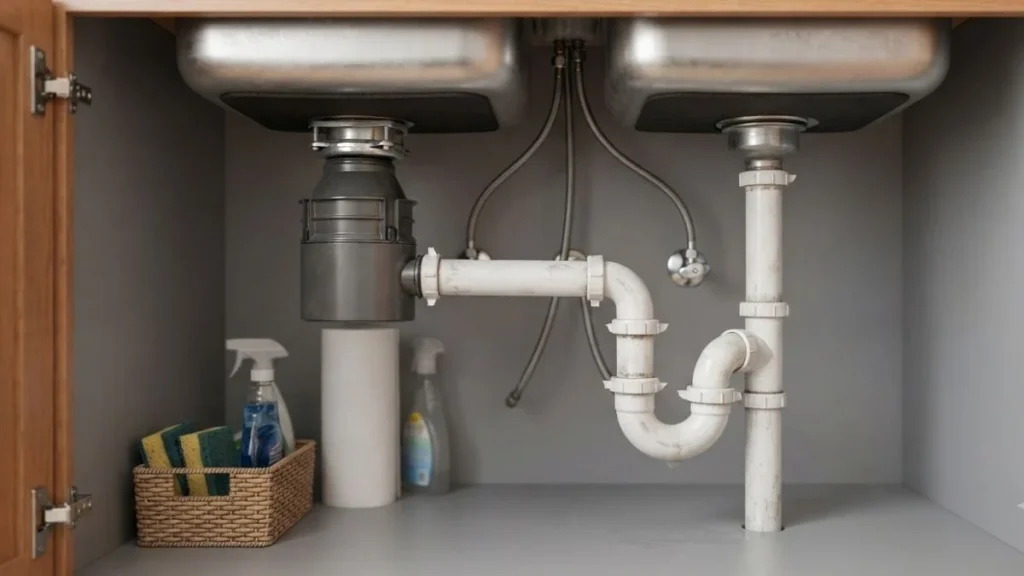
A double P trap occurs when two P-shaped bends exist in the same drain line. Instead of one smooth flow path from the sink to the wall drain, water must travel through two separate curved sections. This creates what plumbers call a “double trap” or “double-trapped drain,” and it’s one of the most common plumbing mistakes found in older homes and DIY renovation projects.
How Does It Happen?
Double P traps don’t usually happen by accident. They typically result from one of these situations:
- A previous homeowner extended the drain line using extra fittings without removing the original trap
- A quick-fix plumbing job that prioritized convenience over code compliance
- A kitchen remodel where new cabinetry forced the drain pipes to be rerouted improperly
- Incorrect installation of a double-bowl kitchen sink where both basins were given their own separate traps and then connected in series
In many cases, the homeowner or amateur plumber simply didn’t know that doubling up on traps creates more problems than it solves.
Is a Double P Trap a Plumbing Code Violation?
Yes — and this is not a gray area. Both of the primary plumbing codes used across the United States explicitly prohibit double trapping a single fixture.
What the International Plumbing Code (IPC) Says
The International Plumbing Code, which has been adopted by the majority of U.S. states and municipalities, states in Section 1002.1 that every fixture must be separately trapped and that no fixture shall be double trapped. The intent of this rule is clear: each drain line should have exactly one water seal. Adding a second trap disrupts the flow and defeats the purpose of the first.
What the Uniform Plumbing Code (UPC) Says
The Uniform Plumbing Code, used primarily in Western states including California, takes the same position. Under the UPC, a double-trapped drain is considered improper installation. The code requires that trap arms connect directly to the drainage system without creating a second sealed section in the same line.
State and Local Code Variations
While the IPC and UPC set the national standard, your local jurisdiction may have additional requirements or slight variations. Some older municipalities still operate under legacy codes that haven’t been fully updated. That said, double trapping is considered a defect under virtually every modern plumbing code in use today.
Will It Fail a Home Inspection?
Yes, in most cases. Licensed home inspectors are trained to identify double P traps as a plumbing deficiency. If you’re selling your home, this issue can come up on the inspection report and potentially delay closing or reduce your negotiating position. Buyers should also be aware — if an inspection reveals a double trap, it’s worth requesting a correction before finalizing the purchase.
Why a Double P Trap Is Bad for Your Plumbing
Beyond the code issue, a double P trap creates real, practical problems that affect how your kitchen sink performs every single day.
It Creates an Air Trap That Kills Drainage
The biggest functional problem with a double P trap is that it creates an air pocket between the two sealed sections. When water flows down the drain, it has to push through both curves. The air trapped between them has nowhere to escape, which creates a vacuum effect. This is why sinks with double P traps almost always drain slowly — and why plunging or drain cleaners rarely solve the problem permanently.
Standing Water and Sewer Gas Risks
The space between two traps can collect standing water that sits for days or weeks without moving. This stagnant water becomes a breeding ground for bacteria, mold, and biofilm. More seriously, if the water seal in either trap evaporates or gets siphoned away — which happens more easily in a double-trap setup — sewer gases can enter your kitchen through the drain. Hydrogen sulfide, even at low concentrations, causes headaches, nausea, and respiratory irritation.
Long-Term Pipe Damage and Clogs
Food particles, grease, and soap scum that flow down your drain tend to accumulate in the low points of the trap. With two traps instead of one, there are twice as many collection points for debris. Over time, this leads to stubborn clogs that are difficult to clear without disassembling the pipes entirely. It also accelerates corrosion in metal trap assemblies.
How to Identify a Double P Trap Under Your Kitchen Sink
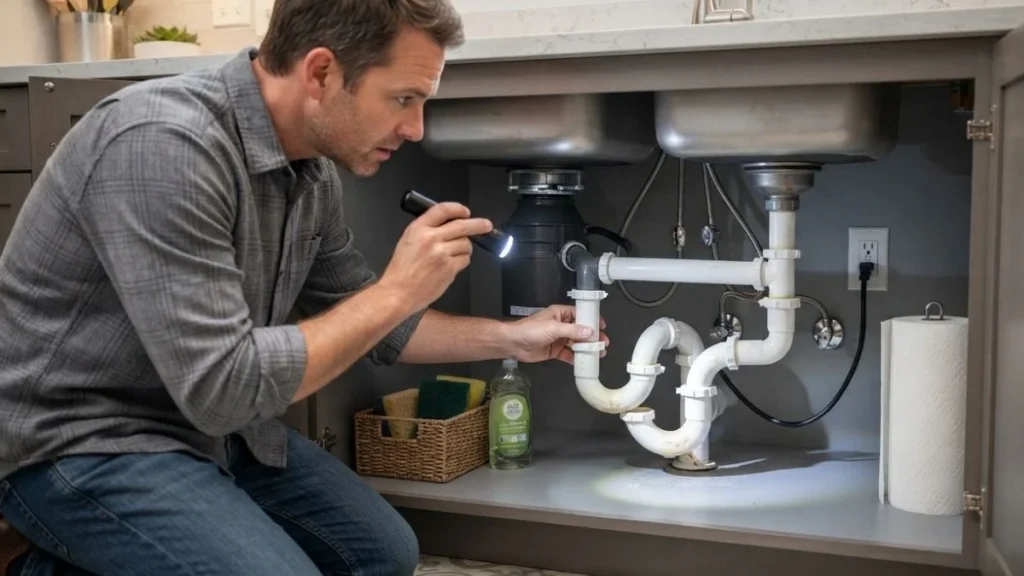
You don’t need a plumber to spot this problem. A basic visual inspection is usually enough.
Open the cabinet doors under your kitchen sink and trace the drain pipe with your eyes. Starting at the bottom of the sink strainer, follow the tailpiece down to where it begins to curve. A properly installed single P trap will curve down, loop back up, and then head straight into the wall or floor drain. A double P trap will curve down, back up, then curve down again before reaching the drain — creating an S-shape or a double-loop configuration.
Common warning signs include:
- Slow draining that persists even after cleaning the drain
- Gurgling or bubbling sounds when water drains
- A persistent musty or sewage-like smell from the sink
- Visible S-curve or two separate curved sections under the sink
How to Fix a Double P Trap Under Your Kitchen Sink
The good news is that fixing a double P trap is one of the more straightforward plumbing corrections a homeowner can make. In most cases, it’s a DIY-friendly job that takes under an hour.
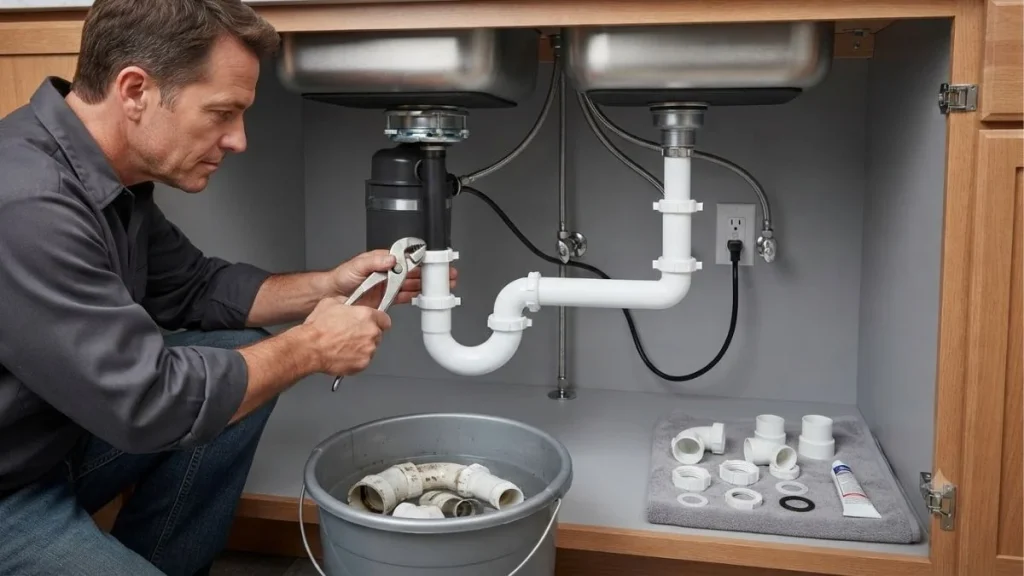
DIY Fix — Replumbing the Drain Line
Tools and materials you’ll need:
| Item | Purpose |
| Slip-joint pliers | Loosening and tightening slip nuts |
| P trap kit (1-1/2″) | Replacement trap assembly |
| Drain extension tube | Connecting trap to wall drain |
| Plumber’s tape (Teflon) | Sealing threaded connections |
| Bucket and towels | Catching water during disassembly |
Step-by-step process:
- Clear out the cabinet under the sink and place a bucket beneath the existing trap to catch water.
- Use slip-joint pliers to loosen the slip nuts on both ends of the existing trap assembly. Remove all trap components.
- Measure the distance from the bottom of the tailpiece to the center of the wall drain opening. The P trap should sit so that the trap arm enters the wall drain at a slight downward slope (approximately 1/4 inch per foot).
- Assemble the new single P trap kit, connecting the trap arm to the wall drain stub-out. Make sure the trap arm has a consistent downward pitch — never uphill.
- Tighten all slip nuts by hand first, then snug them with pliers. Avoid overtightening, which can crack plastic fittings.
- Run water for 30 seconds and check all connections for leaks.
When to Call a Licensed Plumber
DIY replacement works well when the drain rough-in (the wall pipe opening) is at the right height — typically 16 to 20 inches from the finished floor. If the wall drain is positioned too high or too low, a single P trap simply won’t fit correctly without repositioning the drain rough-in, which requires cutting into the wall. In that case, calling a licensed plumber is the right move. Expect to pay between $150 and $400 for a professional P trap replacement, depending on your location and the complexity of the job.
How to Prevent Double P Trap Problems in the Future
Once you’ve corrected the issue, a few simple habits will keep your kitchen drain running properly for years.
Always verify the rough-in height before installing a new sink or replacing trap components. If the wall drain is at the wrong height from the start, plumbers and DIYers alike tend to compensate with extra fittings — which is exactly how double traps get created.
For double-bowl kitchen sinks, use a center outlet drain kit with a continuous waste pipe that channels both bowls into a single trap. This is the code-compliant way to handle dual basins and eliminates any temptation to install separate traps for each bowl.
Read Also: Pipes under Kitchen Sink Came Apart
Conclusion
A double P trap under your kitchen sink is more than just an eyesore — it’s a plumbing code violation that causes slow drains, sewer gas exposure, and recurring clogs. The good news is that it’s one of the easier plumbing problems to fix, whether you tackle it yourself over a weekend or bring in a licensed plumber for a professional repair.
If you suspect you have a double P trap, don’t ignore it. Take 10 minutes to inspect your under-sink plumbing, identify the issue, and take action. Your kitchen drain — and your home’s air quality — will be better for it.