

Water and basements have never been friends — and a walkout basement makes that relationship even more complicated. That sunken stairwell outside your basement door is essentially a built-in water trap, and without proper drainage, every heavy rainstorm is a risk.
What starts as a small puddle at the base of your stairs can quickly turn into a flooded basement, foundation damage, and a mold problem that costs thousands to fix. The worst part? Most homeowners ignore basement walkout stair drainage until the damage is already done.
The good news is this is a completely fixable problem. Whether you’re dealing with no drainage at all, a clogged old drain, or poor grading around the stairwell — proven solutions exist for every situation and every budget. This guide covers the causes, the best drainage solutions, real cost estimates, and simple maintenance tips to keep your basement dry for good.
Common Causes of Basement Walkout Stair Drainage Problems

Before you can fix the problem, you need to understand what’s causing it. Most drainage failures in walkout stairwells come down to one or more of these root causes.
Poor Grading Around the Stairwell
Grading refers to the slope of the soil around your home. The ground should always slope away from the foundation at a rate of about 6 inches for every 10 feet. When the grading is flat or slopes toward the stairwell, rainwater and snowmelt naturally funnel right into that sunken area. Over time, soil also settles and compacts, making grading problems worse even in homes that were properly graded when first built.
Lack of a Proper Drainage System
Many homes simply weren’t built with dedicated stairwell drainage. Builders sometimes install a basic floor drain at the bottom of the stairwell, but without a proper channel system or connection to a sump pump or daylight outlet, that drain can only handle so much water before it’s overwhelmed. Older homes especially tend to have undersized or entirely absent drainage infrastructure in the stairwell area.
Clogged or Failing Existing Drains
If your home does have a drain, that doesn’t mean it’s working. Leaves, dirt, sand, and organic debris accumulate in drain channels and grates over time. A partially or fully clogged drain is almost worse than no drain at all — it gives homeowners a false sense of security while water backs up and sits against the foundation. Drain pipes also deteriorate, shift, and collapse over the years, particularly in regions with freeze-thaw cycles.
Roof Runoff and Surface Water Channeling
Your stairwell doesn’t only collect rain that falls directly into it. If your gutters are overflowing or your downspouts aren’t directed far enough away from the house, roof runoff ends up pooling near the stairwell. Hard surfaces like driveways and patios also shed water quickly, and if they slope toward the stairwell opening, they essentially act as a funnel directing even more water into an already vulnerable spot.
How to Identify a Basement Walkout Stair Drainage Problem

Warning Signs to Watch For
- Standing water at the base of the stairs after moderate to heavy rain
- White chalky deposits (efflorescence) on stairwell walls — a sign water is moving through the concrete
- A persistent musty or earthy smell near the basement entry door
- Visible cracks along the base or sides of the stairwell walls
- Rust stains around drain grates indicating long-term standing water
- Peeling paint or moisture bubbling on the basement door frame
- Water stains on the basement floor just inside the walkout door
How to Inspect Your Stairwell Drainage Yourself
You don’t need to be a contractor to do a basic drainage inspection. Start by examining the stairwell on a dry day. Look at the slope of the stairwell floor — does it angle toward the drain or away from it? Pour a bucket of water into the stairwell and watch where it goes. If it drains slowly, sits and pools, or moves toward the walls instead of the drain, you have a drainage problem.
Next, check the drain grate. Remove it and look for debris buildup. Run a garden hose into the drain for 30 to 60 seconds. If the water backs up quickly rather than flowing away freely, the drain pipe is either clogged, undersized, or has collapsed somewhere along its run. At that point, it’s worth calling a licensed waterproofing contractor for a camera inspection of the drain line.
Best Basement Walkout Stair Drainage Solutions

There is no one-size-fits-all solution here. The right approach depends on your stairwell’s size, your soil conditions, how severe the water intrusion is, and your budget. Here’s a breakdown of the most effective options.
Surface Drainage Channels (Trench Drains)
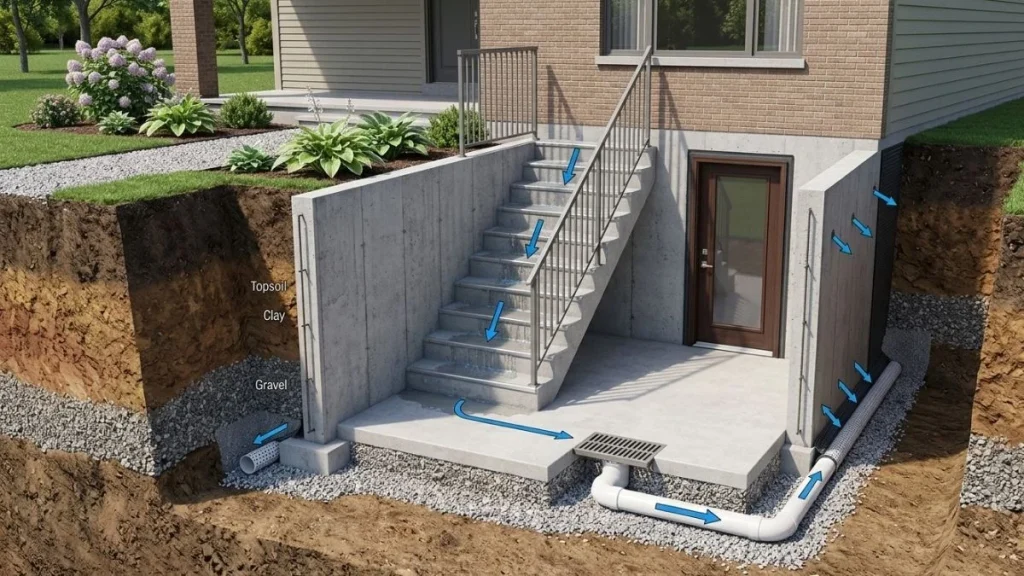
A trench drain — also called a channel drain or linear drain — is the most common and effective solution for basement walkout stair drainage. It’s a long, narrow channel installed at the base of the stairs and sometimes along both sides of the stairwell. Water flows into the channel through a grated cover and is directed away through a connected drainpipe to a daylight outlet, dry well, or municipal storm system.
Trench drains are available in polymer concrete, stainless steel, and PVC. For most residential stairwells, a polymer concrete or PVC channel with a heavy-duty grate is the sweet spot between durability and cost. The key to making them work is ensuring the channel is slightly recessed below the stairwell floor level so water naturally flows into it, and that the connected pipe has adequate slope — at least 1% grade — to keep water moving without pooling.
How to Install a Trench Drain at Basement Walkout Stairs
- Mark the drain channel location at the base of the stairs and along sides if needed
- Saw-cut the existing concrete and excavate a trench slightly wider and deeper than the drain body
- Bed the channel in concrete and set it slightly below the finished floor surface
- Connect the outlet end to a 4-inch drainpipe sloped toward a daylight outlet or dry well
- Backfill around the channel with concrete and allow to cure fully before use
- Install the grate cover and test with a hose before the next rain event
French Drain System for Walkout Basement Stairs
A French drain is a subsurface drainage solution that intercepts groundwater before it reaches your stairwell. It consists of a perforated pipe wrapped in filter fabric and surrounded by gravel, buried at a depth that allows it to capture water moving through the soil. For walkout stairwells, a French drain is typically installed along the outer perimeter of the stairwell walls at a depth of 18 to 36 inches.
French drains work best when the stairwell drainage problem is coming from groundwater seeping through the soil rather than surface water pooling. They’re also an excellent complement to a trench drain — the trench drain handles surface water while the French drain intercepts subsurface water before it reaches the wall. The pipe should have a minimum slope of 1% and terminate at a daylight outlet at least 10 feet from the foundation.
Sump Pump Integration
In areas with high groundwater tables or where gravity drainage isn’t possible, a sump pump may need to be integrated into the stairwell drainage system. A collection basin is installed at the lowest point of the drainage system — typically at the base of the stairwell — and a submersible sump pump inside the basin activates automatically when the water level rises, pumping water up and away from the foundation through a discharge pipe.
This is often the best solution in flat lots where there’s nowhere to daylight a drain by gravity. It adds ongoing maintenance requirements (the pump needs to be tested regularly and eventually replaced), but it’s a highly reliable solution for serious water management problems.
Waterproofing Membranes and Sealant Coatings
Waterproofing the stairwell walls and floor is an important complementary step, but it’s not a replacement for proper drainage. Elastomeric coatings, crystalline waterproofing products, and sheet membrane systems can significantly reduce the amount of water that seeps through porous concrete stairwell walls. These products work best when applied to clean, prepared concrete surfaces and are particularly useful on stairwells with visible efflorescence or minor seepage.
Grading and Landscaping Corrections
Fixing the grade around your stairwell is often the most cost-effective first step you can take. If the soil around the stairwell slopes toward it, adding and compacting soil to create a positive slope away from the opening costs very little. Adding a small earthen berm or swale — a shallow, curved channel that redirects surface water — around the perimeter of the stairwell opening can dramatically reduce how much surface water reaches the stairwell in the first place.
DIY vs. Hiring a Professional
| Task | DIY Friendly? | Difficulty | Notes |
|---|---|---|---|
| Cleaning clogged drain grates | Yes | Easy | Seasonal maintenance task |
| Grading/soil adjustment | Yes | Easy | Basic shovel work, no permits |
| Applying waterproof sealant | Yes | Easy | Surface must be dry and clean first |
| Trench drain installation | Possible | Medium | Requires concrete cutting skills |
| French drain installation | Rarely | Hard | Depth, slope, and outlets matter critically |
| Sump pump installation | No | Hard | Requires licensed plumber in most states |
When hiring a contractor, always ask for proof of license and insurance, a written warranty on the drainage system, and references from similar stairwell drainage projects. A reputable waterproofing contractor will also assess the broader water management picture around your home — not just the stairwell — before recommending a solution.
How Much Does Basement Walkout Stair Drainage Cost?
| Solution | DIY Cost Range | Professional Cost Range |
|---|---|---|
| Trench drain installation | $150 – $400 | $800 – $2,500 |
| French drain system | $200 – $600 | $1,500 – $4,000 |
| Sump pump addition | $300 – $700 (pump only) | $1,000 – $3,000 |
| Waterproof coating/sealant | $50 – $200 | $300 – $800 |
| Full stairwell waterproofing system | Not recommended | $3,000 – $8,000+ |
Costs vary significantly based on your region, the size of the stairwell, soil conditions, and the severity of existing water damage. Getting two or three quotes from licensed waterproofing contractors in your area is always worthwhile before committing to a solution. Also check whether your homeowner’s insurance policy covers any portion of water damage repair — some policies include coverage for sudden water intrusion but not long-term seepage.
Maintenance Tips to Keep Your Drainage Working Year-Round
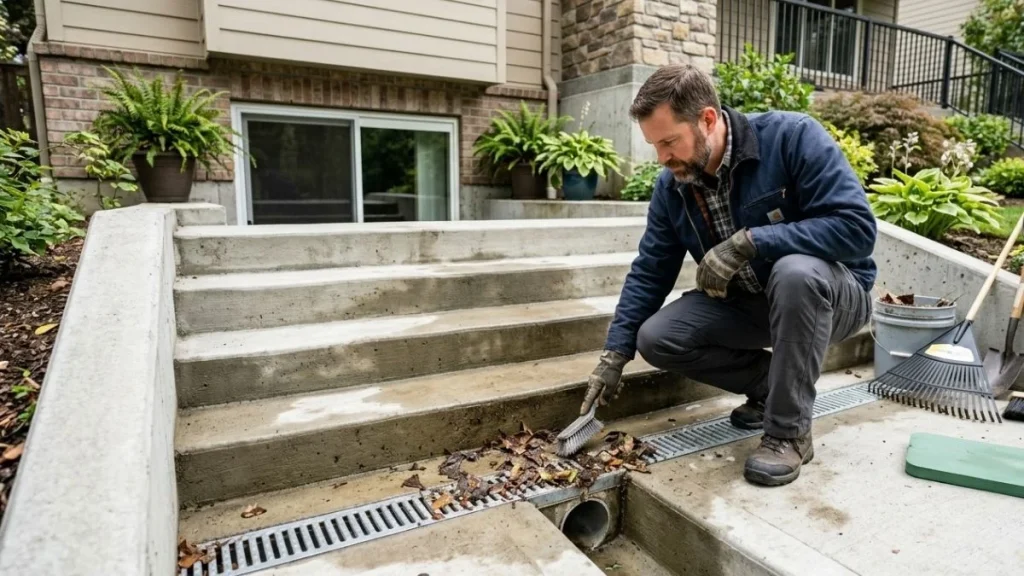
Installing a drainage system is only half the battle. Without regular maintenance, even the best drainage systems fail over time. Here’s a simple seasonal checklist to keep everything working properly.
Seasonal Maintenance Checklist
- Spring: Clear any debris that accumulated over winter. Inspect drain grates for damage. Test the drain with a garden hose to confirm free flow.
- Summer: Check for root intrusion near French drains if you have trees or large shrubs nearby. Make sure downspouts are still directed away from the stairwell area.
- Fall: This is your most critical maintenance window. Remove fallen leaves from drain channels before heavy autumn rain. A clogged drain in November means a flooded stairwell by December.
- Winter: In cold climates, ensure drain grates are not covered with ice. A frozen drain is the same as a blocked one. If you have a sump pump, test it monthly and consider a battery backup in case of power outages during winter storms.
In addition to seasonal checks, have a professional inspect your drainage system every two to three years. Drain pipes shift, connections loosen, and sumps wear out. A short inspection is far cheaper than discovering a failed drain after a flood.
Read Also: Basement Stair Drain Clogged
Conclusion
Basement walkout stair drainage isn’t the most exciting home improvement project, but it’s one of the most important. Water is patient — it finds every crack, every gap, and every low point over time. The good news is that with the right drainage system, proper grading, and a simple maintenance routine, you can keep your walkout stairwell completely dry through any storm.
Start with an inspection. If the problem is minor, a grading fix and a clean drain may be all you need. If water is a recurring issue, invest in a proper trench drain and French drain system before the next rainy season arrives. And when in doubt, bring in a licensed waterproofing contractor for a professional assessment — most offer free evaluations, and the peace of mind is well worth the call.