

Are your cabinet doors loose or sagging because the hinge holes in your particle board are worn out? You’re not alone, and the good news is that fixing this problem is easier than you think.
When hinge holes get damaged, your cabinet doors won’t close properly, making your kitchen or workspace look messy and feel frustrating to use. But don’t worry—this guide will show you simple, effective ways to repair those holes and restore your cabinet doors to perfect working order.
Assessing Damage To Hinge Holes
Repairing cabinet door hinge holes in particle board starts with assessing the damage. The hinge holes often wear out due to repeated use or moisture exposure. This step saves time and ensures the cabinet door fits securely again. Careful inspection of the holes and the particle board will reveal whether the damage is minor or needs more work. A thorough assessment prevents future problems and keeps your cabinet strong and functional.
Identifying Loose Or Stripped Holes
Loose or stripped hinge holes cause the cabinet door to sag or wobble. These holes no longer hold screws tightly, making the door unstable. To identify this type of damage:
- Check if the hinge screws spin without tightening.
- Look for visible cracks or enlarged holes around screw areas.
- Test the door by opening and closing it; loose hinges cause uneven movement.
Loose holes often have worn-out edges and reduced grip for screws. Stripped holes are usually wider than the screw size, which prevents proper fastening. Sometimes, you can hear a clicking sound when the door moves, indicating play in the hinge area.
| Symptom | Description | Impact on Cabinet Door |
| Screw Spins Freely | Thread inside the hole is worn or missing | Door feels loose and unstable |
| Enlarged Hole | Hole is wider than screw diameter | Hinge does not hold tight |
| Cracks Around Hole | Particle board shows damage or splitting | Risk of hinge pulling out completely |
Identifying these signs early stops the damage from getting worse. Fixing loose or stripped holes is simpler when caught in time.
Checking Particle Board Integrity
The strength of particle board around hinge holes is vital. Damaged or weak particle board cannot hold screws properly. Check for these signs of particle board problems:
- Soft or crumbly texture around the hinge area.
- Swelling or bubbling caused by moisture.
- Visible cracks or chips near the holes.
- Discoloration indicating water damage or mold.
Particle board often fails due to water exposure or heavy stress. Use a small screwdriver or awl to gently press near the hinge holes. Soft spots mean the board is damaged and needs repair or replacement.
Here is a quick checklist to evaluate particle board integrity:
- Press lightly around hinge holes for soft areas.
- Inspect for signs of water damage or mold.
- Look for cracks, chips, or swelling.
- Check if screws can grip firmly without wobbling.
Healthy particle board feels solid and resists pressure. Damaged board feels weak and breaks easily. Identifying particle board condition helps decide if simple hole repair works or if you need to reinforce the area.
Preparing The Cabinet Door
Repairing cabinet door hinge holes on particle board starts with proper preparation. Preparing the cabinet door carefully ensures a strong, lasting fix. Particle board is soft and prone to damage. Taking time to remove hardware and clean the damaged area makes the repair easier and more effective. The right steps help the glue or filler stick well and keep the door functional for years.

Removing Hardware
Begin by removing all hardware attached to the cabinet door. This includes hinges, screws, handles, and any other metal parts. Removing hardware prevents damage and gives clear access to the damaged hinge holes. Use a screwdriver that fits the screws to avoid stripping them.
- Step 1: Lay the door flat on a soft surface to avoid scratches.
- Step 2: Unscrew each hinge carefully and keep the screws and hinges in a labeled container.
- Step 3: Remove handles or knobs, if present, to clear the entire working area.
Keeping track of all hardware parts is important. Use a small box or ziplock bag and label it with the door’s name or location. This helps during reassembly and avoids losing screws.
| Tool | Purpose |
| Screwdriver (Phillips or flathead) | Remove screws from hinges and handles |
| Soft cloth or towel | Protect the door surface while working |
| Container or bag | Store hardware safely |
Once all hardware is removed, inspect the hinge holes. Note the size and shape of the damage. This helps decide the next repair steps.
Cleaning And Sanding The Area
Cleaning the hinge hole area is essential before repair. Dirt, dust, and old glue reduce the strength of new filler or glue. Use a brush or vacuum to remove loose particles. Wipe the area with a damp cloth and allow it to dry completely.
Sanding smooths rough edges and creates a better surface for repair materials to bond. Use medium-grit sandpaper (around 120 grit) for the first sanding. Sand inside and around the hole gently. Avoid sanding too deep, as particle board is fragile.
- Remove all loose fibers and splinters.
- Make the surface even and clean.
- Focus on the edges of the hole to create a neat working area.
After sanding, wipe the area with a dry cloth to remove dust. A clean surface improves adhesion and helps the repair last longer. Let the door dry fully if moisture was used in cleaning.
| Step | Reason |
| Brush or vacuum | Remove dust and debris |
| Damp cloth wipe | Clean surface dirt |
| Sanding with 120 grit | Smooth edges and rough spots |
| Dry cloth wipe | Remove sanding dust |
Preparing the cabinet door carefully makes the repair process smoother and stronger. Clean, smooth surfaces hold repair materials better. Proper preparation helps restore the cabinet door’s function quickly and effectively.
Filling Damaged Hinge Holes
Repairing damaged hinge holes in particle board cabinet doors is a common task during home maintenance. Filling these holes restores the door’s strength and ensures hinges hold tightly. Particle board is softer than solid wood, so hinge holes can wear out or become loose over time. Filling damaged hinge holes gives a solid base for screws and prevents the door from sagging or misaligning.
Using Wood Filler Or Epoxy
Wood filler and epoxy are popular materials for filling damaged hinge holes. They provide a strong, durable repair that can hold screws firmly. Choose a wood filler or epoxy designed for particle board or wood repair for best results.
Steps for filling hinge holes with wood filler or epoxy:
- Clean the hole from dust and loose material.
- Mix the filler or epoxy as per instructions.
- Fill the hole completely, pressing the filler in tightly.
- Let it dry fully; drying time varies by product.
- Sand the surface smooth to match the cabinet door.
- Drill a new pilot hole for the hinge screw.
- Reattach the hinge with screws.
Table below compares wood filler and epoxy for this repair:
| Feature | Wood Filler | Epoxy |
| Drying Time | Usually 1-2 hours | 2-6 hours |
| Strength | Good for small holes | Very strong, durable |
| Ease of Use | Easy to apply | Requires mixing |
| Finish | Sands smoothly | Can be shaped and sanded |
Tip: Use epoxy for larger holes or when extra strength is needed. Wood filler works well for small repairs.
Inserting Wooden Dowels Or Toothpicks
This method uses small wooden pieces like dowels or toothpicks to fill loose hinge holes. It creates a tight grip for the screws and is a simple, quick fix.
How to fill holes using dowels or toothpicks:
- Clear dust and loose bits from the hole.
- Apply wood glue inside the hole.
- Insert wooden dowels or several toothpicks coated with glue into the hole.
- Break or cut off any extra parts sticking out.
- Allow the glue to dry fully, usually 30 minutes to an hour.
- Drill a new pilot hole carefully into the filled area.
- Screw the hinge back in place securely.
Benefits of this method include:
- Low cost and easy to find materials
- No need for specialized fillers
- Strong hold when glue dries
- Fast drying time
Note: This method works best for holes that are only slightly enlarged or loose. For very damaged holes, combine this with wood filler or epoxy for stronger support.
Re-drilling And Reinforcing
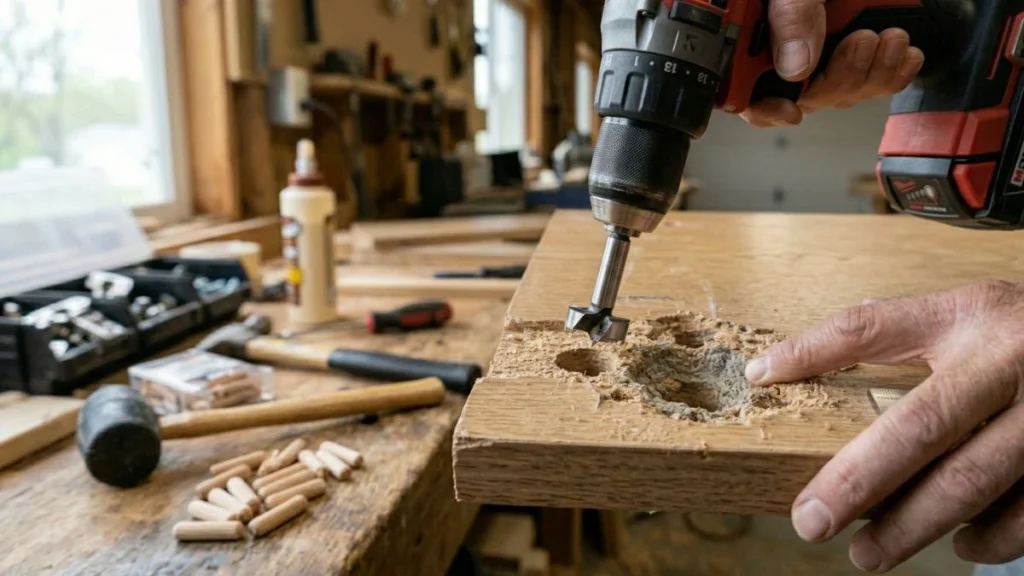
Repairing cabinet door hinge holes in particle board often needs careful re-drilling and reinforcing. Particle board is soft and can crumble easily, so fixing old or damaged hinge holes requires precision. Re-drilling new holes allows better screw grip and proper hinge alignment. Reinforcing the holes strengthens the area, preventing future damage. This process restores the cabinet door’s function and extends its life. Below are key steps to follow for a strong, lasting repair.
Marking New Hole Positions
Start by finding the best spot for the new hinge holes. Old holes might be too large or stripped, so a fresh position helps secure the hinge better. Use the following steps to mark new hole positions:
- Remove the hinge from the door and the cabinet frame.
- Place the hinge on the door in the desired position.
- Use a pencil to mark the center of each new hole on the particle board.
- Double-check measurements to ensure the hinge aligns perfectly with the cabinet frame.
- Mark the matching spots on the cabinet frame for the hinge screws.
Using a ruler or measuring tape ensures accuracy. Marking holes slightly away from damaged areas helps avoid weak spots. Here is a simple table showing the typical hinge hole spacing for standard cabinet doors:
| Cabinet Door Size | Distance Between Hinge Holes | Distance From Edge |
| Small (12-18 inches) | 2.5 inches | 0.5 inches |
| Medium (18-24 inches) | 3 inches | 0.5 inches |
| Large (24+ inches) | 3.5 inches | 0.5 inches |
Tip: Mark lightly and avoid pressing hard to prevent extra holes or damage.
Drilling Pilot Holes
Drilling pilot holes is crucial for clean and precise screw placement. It helps prevent the particle board from cracking or splitting when inserting screws. Follow these steps for effective pilot holes:
- Choose a drill bit smaller than the screw diameter (usually 70-80% of screw size).
- Align the drill bit with the marked hole centers.
- Hold the drill steady and drill straight into the particle board.
- Drill only deep enough to fit the screw length.
Use a drill guide or clamp to keep the drill straight. This step avoids angled holes that reduce hinge stability. A table below shows recommended drill bit sizes based on common screw diameters:
| Screw Diameter | Recommended Drill Bit Size |
| 6 (3.5 mm) | 2.5 mm (3/32 inch) |
| 8 (4 mm) | 3 mm (1/8 inch) |
| 10 (5 mm) | 3.5 mm (9/64 inch) |
Note: Avoid drilling too large holes, as screws will not hold well.
Installing Reinforcement Inserts
Reinforcement inserts provide extra strength to the particle board around hinge holes. They hold screws tightly and prevent the board from crumbling. Here is how to install them:
- Choose inserts made for particle board, such as metal threaded inserts or wooden dowels with glue.
- Clean the pilot holes from dust and debris.
- If using metal inserts, screw them gently into the pilot holes until flush with the surface.
- For wooden dowels, apply wood glue on the dowel and insert it into the hole.
- Allow glue to dry fully before screwing hinges back in place.
Reinforcement inserts improve screw grip and reduce the chance of repeated damage. Below is a comparison of common reinforcement methods:
| Method | Material | Strength | Ease of Installation |
| Metal Threaded Inserts | Metal | High | Moderate |
| Wooden Dowels with Glue | Wood | Medium | Easy |
| Plastic Anchors | Plastic | Low to Medium | Easy |
Tip: Use a screwdriver to tighten screws carefully. Over-tightening can damage the inserts or particle board.
Reattaching The Hinges
Reattaching hinges on cabinet doors made from particle board requires care and precision. Particle board is softer than solid wood and can easily get damaged if hinges are not fixed properly.

Choosing The Right Screws
Choosing the right screws is vital for a strong hinge attachment on particle board. Standard wood screws can strip the soft material, causing loose hinges over time. Use screws designed for particle board or those with special features to hold better.
Key points for selecting screws:
- Length: Screws should be long enough to go deep but not too long to damage the back of the board.
- Diameter: Thicker screws offer better grip but must fit the hinge holes.
- Thread type: Coarse threads work best for particle board as they bite into the material more firmly.
- Material: Use rust-resistant screws, especially in kitchens or bathrooms.
| Screw Type | Best For | Advantages |
| Particle Board Screws | Soft boards | Coarse thread, deeper grip |
| Confirmat Screws | Cabinet assembly | Strong hold, prevents splitting |
| Wood Screws (Coarse Thread) | General use | Easy to find, good grip |
Use a screw that fits the hinge’s original holes. Avoid screws that are too thin or short. Always pre-drill holes slightly smaller than the screw diameter to avoid splitting or cracking the particle board.
Securing Hinges Properly
Properly securing hinges to particle board is crucial. Loose hinges can cause doors to sag or fall off. Follow these steps to ensure a firm attachment.
- Remove old screws and clean holes: Clear any debris or loose material from previous screw holes.
- Fill damaged holes: Use wood filler or glue mixed with sawdust to fill enlarged or stripped holes.
- Let filler dry: Allow enough drying time for the filler to harden fully.
- Pre-drill new holes: Drill pilot holes slightly smaller than screw diameter to guide screws.
- Attach hinges: Place the hinge on the door and insert screws carefully, tightening them evenly.
Tips for better hinge attachment:
- Do not overtighten screws; this can strip the particle board.
- Use a screwdriver instead of a drill for final tightening.
- Check hinge alignment before fully tightening screws.
- Consider using small wooden plugs or toothpicks coated with glue to reinforce screw holes.
Taking time to reattach hinges carefully keeps your cabinet door stable and functional. It helps prevent future repairs and maintains the cabinet’s look and value.
You May Like Also: Remove Arch from Cabinet Doors
Conclusion
Repairing cabinet door hinge holes in particle board saves money and time. Small fixes prevent bigger problems later. Using wood filler or dowels works well for damaged holes. Always let the repair dry fully before reattaching hinges. Tight hinges keep doors aligned and working smoothly.
A little care goes a long way to keep cabinets strong. Try these simple steps for lasting repairs. Your cabinets will look better and last longer. Easy to do, even for beginners. Give your furniture a fresh, sturdy feel today.