


A frozen air conditioner suction line is not a cosmetic problem — it signals that something inside your system has already broken down.
Most homeowners notice ice on the large copper pipe running into their unit and have no idea whether to turn the system off, grab a hair dryer, or call a technician immediately.
This article walks you through the 5 root causes of an air conditioner suction line frozen scenario, what each one means for your system, and exactly which fixes you can handle yourself versus which require a certified HVAC professional.
What’s Actually Happening Inside Your AC
Your evaporator coil runs at around 40°F under normal operating conditions. When something disrupts the system’s balance, coil temperature drops well below that — sometimes below 32°F — and moisture in the air freezes on contact instead of draining away as condensate.

The Suction Line’s Role in Normal Cooling
The suction line is the large-diameter copper pipe that carries low-pressure refrigerant vapor from the evaporator coil back to the compressor. Under normal operation, refrigerant absorbs heat from indoor air as it boils inside the evaporator coil, then travels through the suction line as a cool vapor. That heat exchange keeps the coil surface above freezing.
What Breaks the Balance
Two conditions cause frost accumulation: not enough heat entering the coil, or too much refrigerant flooding it.
Airflow restriction is the most common trigger. When a clogged air filter, failed blower motor, or blocked return vent cuts airflow across the evaporator coil, less heat reaches the refrigerant. The coil surface temperature drops, and ice starts forming at the coil first, then migrates outward along the suction line toward the compressor.
Refrigerant charge imbalance causes the same effect through a different path. Low refrigerant charge causes the expansion valve — the metering device that controls refrigerant flow into the coil — to deliver refrigerant at too low a pressure. That pressure drop causes an extreme temperature drop, freezing the coil and suction line together.
Here’s the problem. Both failure modes look identical from the outside: ice on the suction line. That’s why accurate HVAC diagnostics matter before any repair begins.
The 5 Root Causes — and How to Spot Each One
1. Restricted Airflow Across the Evaporator Coil
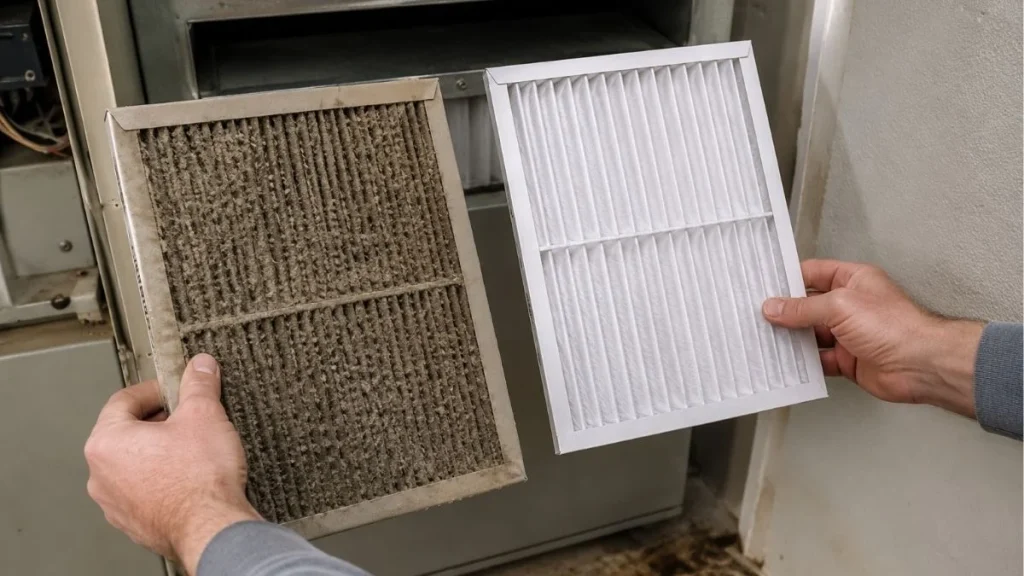
A clogged air filter is the single most common cause of low airflow suction line freezing. When the filter blocks return air, the evaporator coil stops receiving enough warm air to keep its surface above 32°F. Check your filter first — if it’s gray, matted, or hasn’t been changed in over 60 days, that’s your likely culprit.
Blocked supply vents and closed registers create the same problem. Even a well-maintained filter won’t compensate if 4 or 5 vents are shut throughout the house.
2. Low Refrigerant Charge
Low refrigerant charge causes evaporator pressure to drop below the system’s design spec. On an R-410A system, normal suction pressure runs roughly 102–120 PSI at 75°F indoor conditions. Drop below that range and the coil surface temperature falls under 32°F, triggering frost accumulation that spreads outward along the suction line.
Low charge almost always means a leak somewhere in the copper lines or coil — refrigerant doesn’t deplete on its own.
3. Thermal Expansion Valve Malfunction
The thermal expansion valve (TXV) meters refrigerant flow into the evaporator coil. A TXV stuck open floods the coil with excess refrigerant, dropping pressure and temperature sharply. A TXV stuck closed starves the coil, producing weak cooling and eventual icing. Either failure mode requires gauge-based HVAC diagnostics by a certified technician — there is no reliable visual test.
4. Weak or Failing Blower Motor
A failing run capacitor reduces blower motor speed without triggering a full shutdown. The motor keeps running but delivers reduced CFM (cubic feet per minute of airflow). Blower motor amperage draw below the nameplate rating — measured with a clamp meter — confirms this. Carrier and Trane both publish amperage specs in their equipment manuals for exactly this check.
5. Environmental Conditions
High outdoor humidity combined with an undersized or short-cycling system accelerates evaporator coil frost buildup. This is more common in coastal climates like Florida or Louisiana where humidity stays above 70% for months. It is not a standalone cause — it amplifies an existing system imbalance.
How to Identify a Frozen Suction Line
Ice on the large copper pipe running into your air handler is the clearest sign of a frozen suction line — but knowing what you’re looking at prevents misdiagnosis.

Visual Inspection: Ice vs. Condensation
Normal condensation appears as light water beading on the suction line surface, similar to a cold glass on a humid day. A frozen suction line looks completely different: thick, crusty, opaque ice that may extend 12 inches or more from the air handler toward the outdoor unit. In severe cases, the entire evaporator coil freezes into a solid block of ice, visible if you remove the air handler access panel.
Temperature and Pressure Readings
A contact thermometer placed on the suction line should read between 40°F and 55°F under normal operation. Anything at or below 32°F confirms freezing is active or imminent.
Pressure tells the fuller story. On an R-410A system, suction-side pressure below 100 PSI at standard indoor conditions points directly to either low refrigerant charge or airflow restriction — both primary freeze triggers. Only a certified technician with manifold gauges can take this reading safely.
Sounds That Confirm the Problem
Two specific sounds accompany suction line icing:
- Weak or muffled airflow from supply vents, indicating blower motor amperage draw has dropped or airflow restriction is severe
- Rapid compressor cycling — the outdoor unit turning on and off every few minutes — caused by low-pressure cutout switches protecting the compressor from damage
The result? A system that runs constantly but cools nothing, while ice builds deeper into the evaporator coil with every cycle.
Immediate Troubleshooting (Before Calling Someone)
Before spending money on a service call, run through these steps in order. Some frozen suction line cases resolve completely with a filter swap and a thaw cycle.
Step 1: Turn the Compressor Off, Keep the Fan Running
Switch your thermostat to “Fan Only” mode immediately. This keeps the blower motor running, pushing warm air across the frozen evaporator coil to accelerate thawing — the most effective suction line thawing method available without tools. Do not run the compressor while ice is present. Continued operation risks liquid refrigerant slugging back to the compressor, causing permanent damage.
Allow 2 to 4 hours for a fully frozen coil to thaw completely.
Step 2: Replace the Air Filter
Pull the existing filter and inspect it before installing a replacement. A MERV 8-rated filter balances air filter restriction HVAC performance and particle capture for most residential systems. Avoid MERV 13 or higher in standard systems — the added resistance reduces airflow enough to trigger the same low airflow suction line freezing you’re trying to fix.
Step 3: Check Every Supply and Return Vent
Walk the house and confirm all supply vents are open and unobstructed. Furniture, rugs, and closed doors create airflow restriction that accumulates across the system.
Step 4: Verify Thermostat Settings
A thermostat set below 68°F on a humid day forces the system to run longer cycles than the evaporator coil can handle, accelerating frost accumulation. Set it to 72°F or above during the diagnostic period.
When to Stop and Call a Technician
If the suction line refreezes within 12 hours of thawing, the cause is not airflow restriction. At that point, suspect low refrigerant charge, a thermal expansion valve malfunction, or a failing blower motor — all of which require professional HVAC diagnostics and EPA 608-certified refrigerant handling.
How to Thaw a Frozen Suction Line Safely
Thawing a frozen suction line takes patience, not heat. Rushing the process with the wrong tools causes more damage than the ice itself.
The Right Way to Thaw
Follow these steps in exact order:
- Shut off the AC completely at the thermostat and the breaker. Do not leave it in “Fan Only” mode during active thawing if water dripping onto electrical components is a risk.
- Place dry towels under the air handler to catch meltwater. A fully frozen evaporator coil can release a surprising amount of water as it thaws.
- Wrap the suction line in towels soaked in warm — not hot — water. Warm water accelerates the thaw without thermal-shocking the copper line or disturbing refrigerant pressure inside.
- Wait 30 to 60 minutes, then check for active dripping. Full thaw of a heavily iced evaporator coil can take 2 to 4 hours.
- Inspect the condensate drain line before restarting. Meltwater from frost accumulation can overflow a clogged drain pan, causing water damage to ceilings or walls below the air handler.
What Not to Do
Never use a heat gun, hair dryer, heat lamp, or open flame near the suction line. Copper conducts heat rapidly — concentrated heat spikes internal refrigerant pressure and can rupture the line or damage the expansion valve seat.
Before You Restart
Here’s what most people miss: thawing the line fixes nothing on its own. If the underlying cause — airflow restriction, low refrigerant charge, or thermal expansion valve malfunction — is still present, the suction line will refreeze within one cooling cycle. Confirm the root cause is resolved before switching the system back on.
You May Read Also: Cold Air Blowing Out of Return Vent
Should You Keep Your AC Off While Frozen?
Running your compressor with a frozen suction line forces liquid refrigerant back into the compressor — a condition called liquid slugging that destroys internal valves and bearings, often requiring full compressor replacement at $1,500 or more. Shut the system off at the breaker now, work through the airflow and filter checks in section 5, and if the line refreezes after thawing, call an EPA 608-certified HVAC technician to test refrigerant charge levels and inspect the expansion valve before running the system again.