

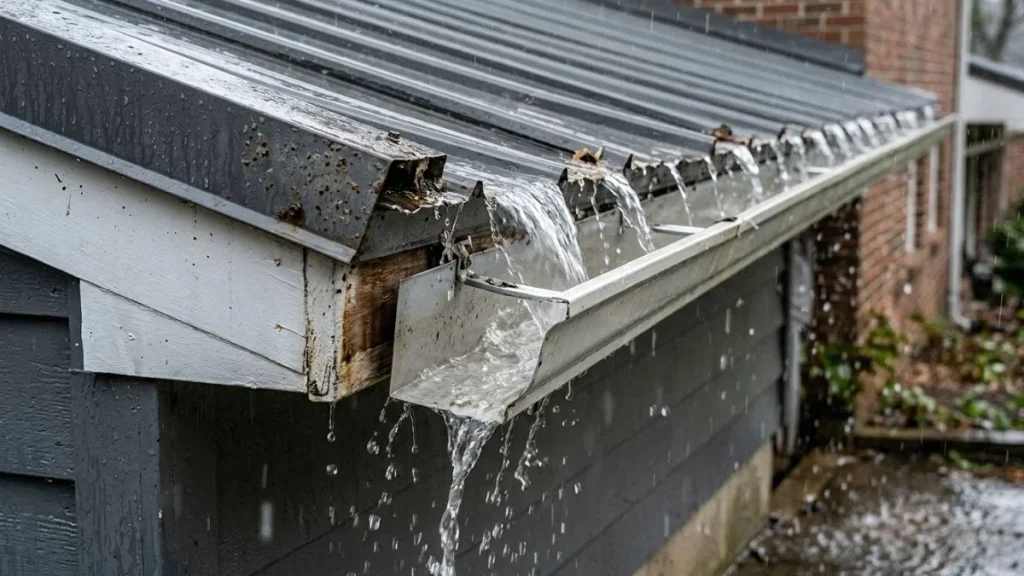
If you’ve ever stood by a window during a heavy rainstorm and watched water pour right over your gutters instead of into them — you’re not imagining things. This is one of the most frustrating and commonly misunderstood problems metal roof homeowners deal with. The gutters are clean, they’re attached properly, but the water just flies past them like they aren’t even there.
The truth is, metal roofs behave very differently from asphalt shingles when it comes to water runoff. The smooth surface, the slope, and the wide panel design all work together to send rainwater off your roof at a much higher speed and volume than most standard gutters are designed to handle. And when that water misses the gutter, it doesn’t just look bad — it quietly causes serious damage to your foundation, landscaping, siding, and fascia boards over time.
What Does “Water Overshooting Gutters” Actually Mean?
Water overshoot happens when rainwater flows off a roof with enough speed and force that it completely misses the gutter below — sailing past the edge and falling directly to the ground. Instead of flowing down into the gutter channel and out through the downspout, the water arcs outward and lands several inches (sometimes feet) away from where it should.
On an asphalt shingle roof, the textured surface slows water down through friction. The granules on shingles act almost like tiny speed bumps, breaking up the water flow and reducing its velocity before it reaches the edge. Metal roofs have no such texture. The surface is smooth, often painted or coated, and water runs across it with very little resistance.
Add a steep pitch — say, anything above a 6:12 slope — and you’ve got water moving fast enough by the time it reaches the eave that a standard 4-inch or 5-inch gutter simply can’t catch it all. It’s not that your gutters are broken. It’s that they were never designed for the volume and speed that a metal roof produces.
Common Causes of Water Overshooting Gutters on a Metal Roof
Understanding the root cause at your home is the key to choosing the right fix. In most cases, it’s not just one thing — it’s a combination of factors working against you.
1. Gutters Are Too Small for the Roof’s Water Volume
This is the most common cause. Most homes come with 4-inch or 5-inch K-style gutters, which are fine for asphalt shingle roofs. But metal roofs dump water off the edge much faster and in greater concentration, and those narrow gutters get overwhelmed almost instantly during moderate to heavy rain.
A good rule of thumb: for every 100 square feet of roof surface, your gutter system needs to handle roughly 1 inch of rainfall per hour. On a metal roof with a steep pitch, that number climbs significantly. If your gutters haven’t been upsized since the metal roof was installed, this is very likely contributing to your problem.
2. Missing or Improperly Installed Drip Edge
A drip edge is a metal flashing strip installed along the roof’s edge that directs water away from the fascia and into the gutter. On metal roofs, this piece is critical — and it’s often installed incorrectly or skipped entirely.
When the drip edge is missing, water follows the underside of the roofing panel and drips directly onto the fascia board. It then runs down behind the gutter rather than into it. Over time, this leads to both the overshoot problem and rotting fascia boards — two problems for the price of one.
3. Steep Roof Pitch
The steeper your roof, the faster water moves. On a roof with a 6:12 or steeper pitch, water reaches the gutter edge with significant velocity and momentum. Rather than dropping straight down into the gutter, it carries outward and overshoots it.
This is purely physics. The fix isn’t to reduce your pitch — it’s to adjust how water is received at the gutter line.
4. Incorrect Gutter Positioning on the Fascia
Even if you have the right size gutter, if it’s installed too low on the fascia, water will arc right past it. The top of the gutter should sit just below the roof’s drip line so that water naturally falls into the channel rather than over the front edge.
Many gutters are installed by carpenters or general handymen who don’t account for metal roof runoff speeds. A gutter that’s even an inch too low can miss a significant portion of the water during heavy rain.
5. Clogged Gutters
A partially or fully clogged gutter has much less capacity to handle water. Even if the gutter was properly sized when it was clean, a blockage from leaves, debris, or standing sludge reduces that capacity dramatically. Water hits the backed-up surface and bounces or flows over the edge.
This one is the most preventable cause on the list — and the most overlooked.
6. Improper Gutter Slope
Gutters need to slope toward the downspout at approximately ½ inch for every 10 feet of run. If your gutters are level or sloped in the wrong direction, water backs up, the gutter fills, and overflow begins well before it should. This is a common installation mistake that’s easy to miss with the naked eye.
The Real Damage Water Overshoot Causes Over Time

It’s easy to dismiss water overshoot as a cosmetic issue. It isn’t. The damage builds gradually, but by the time it becomes obvious, repairs are already expensive.
Foundation and Basement Problems — Water that consistently falls near the base of your home saturates the soil around your foundation. Over months and years, this creates hydrostatic pressure against foundation walls, which leads to cracks, seepage, and in serious cases, structural shifting. Wet basements and musty crawl spaces are often traced directly back to chronic gutter overflow or overshoot.
Fascia Board and Soffit Rot — When water runs behind the gutter instead of into it, it soaks into the wooden fascia board repeatedly. Wood rot sets in slowly — sometimes invisibly for years — until the fascia is soft, crumbling, and needs full replacement. Soffit damage often follows, as moisture wicks upward and creates conditions for mold and insect infestation.
Landscaping and Soil Erosion — Constant water impact in the same area washes away mulch, kills plants, and erodes topsoil from garden beds. Drip lines from overshoot create trenches and bare patches over time.
Exterior Wall and Siding Damage — Water that splashes against siding repeatedly causes paint to peel, promotes mold and mildew growth, and degrades siding materials faster than normal weathering would.
How to Fix Water Overshooting Gutters on a Metal Roof

The good news: most overshoot problems are fixable. Some solutions cost very little. Others require professional installation. Start from the simplest fixes and work your way up.
Upgrade to 6-Inch Gutters
If your home still has 4-inch or 5-inch gutters with a metal roof, upgrading to 6-inch K-style gutters is often the single most effective change you can make. Six-inch gutters handle roughly 40% more water volume than 5-inch gutters, and they’re now considered the industry standard recommendation for metal roofing systems.
Seamless aluminum 6-inch gutters are the most popular choice — they’re lightweight, corrosion-resistant, and eliminate the joint leakage that sectional gutters suffer from. Copper gutters are a premium option with exceptional longevity but come at a significantly higher cost.
Install or Correct the Drip Edge
If your metal roof doesn’t have a properly installed drip edge — or if the existing one is bent, gapped, or directing water behind the gutter — this needs to be corrected before anything else. A correctly installed drip edge overlaps the back of the gutter and ensures water flows cleanly into the channel.
This is a job most experienced roofers can complete quickly. It’s not a major project, but it requires removing a section of the bottom metal panel edge to install correctly. Not a typical DIY task unless you’re comfortable on a roof.
Add Splash Guards or Rain Diverters
Splash guards are angled metal pieces installed at corners, valleys, or high-flow zones of the gutter where water tends to overflow. They act as barriers that redirect fast-moving water back into the gutter channel rather than letting it escape over the side.
Rain diverters are small metal strips attached to the roof surface to redirect concentrated water streams — particularly in roof valleys where two planes meet and dump a heavy volume of water into one spot. Both are inexpensive, widely available at home improvement stores, and can be installed without professional help in most cases.
Reposition the Gutters Higher on the Fascia
If your gutters are positioned too low, they can often be remounted higher — closer to the roofline — to better intercept water coming off the metal panels. A general rule: the back of the gutter should be no more than 1 inch below the roof’s drip edge.
This adjustment requires removing and reattaching the gutter brackets, which is a manageable DIY project with the right tools and a helper. If the fascia board is already damaged or rotted, that needs to be replaced first.
Install a Gutter Apron
A gutter apron is a metal flashing piece that bridges the gap between the roof decking and the back of the gutter. Unlike a standard drip edge (which sits under the roofing material), a gutter apron is installed on top of the decking and bends down into the gutter.
This is especially useful on older metal roofs where the original installation didn’t account for adequate water transition from roof to gutter. It’s a targeted fix that costs very little in materials and makes a noticeable difference.
Clean and Maintain Gutters on a Regular Schedule
| Maintenance Task | Recommended Frequency |
| Full gutter cleaning | Twice a year (spring and fall) |
| Visual inspection after storms | After every major storm |
| Downspout flush check | Once a year |
| Gutter guard inspection | Annually |
Keeping gutters clear should be considered basic maintenance — especially with a metal roof. Gutter guards designed for high-volume flow (micro-mesh is the best option) can significantly reduce the cleaning burden while keeping capacity high.
Recommended: How to Install Gutter Guards on Metal Roof
When to Call a Professional
Some overshoot situations go beyond what a DIY fix can solve. Call a licensed roofing or gutter contractor if:
- Water is getting inside walls, the attic, or the basement
- Fascia boards are visibly soft, cracked, or pulling away
- The gutters are sagging or separating from the fascia
- You’ve tried multiple fixes and overshoot continues
- The roof pitch is steep enough that safe access is a concern
When hiring, ask specifically about experience with metal roof drainage systems. Not every contractor who installs gutters understands the unique runoff characteristics of metal roofing. Ask for references from similar projects and get at least two quotes before committing.
Preventive Tips to Avoid Overshoot From the Start
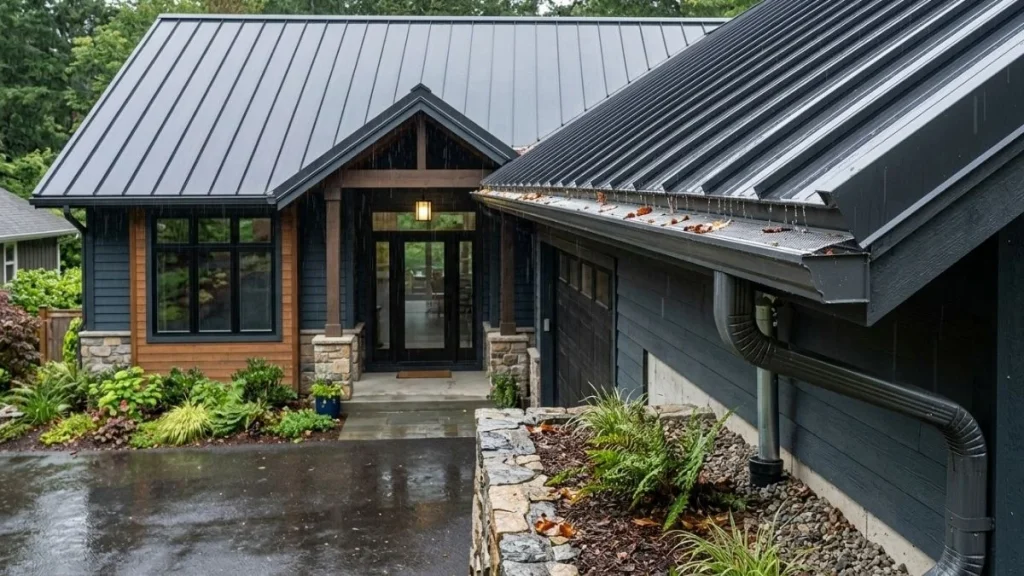
If you’re planning a new metal roof installation or replacing gutters, these steps will save you significant headaches:
- Always pair a metal roof installation with 6-inch gutters, not 5-inch
- Insist on a properly installed drip edge as part of the roofing contract
- Use seamless gutters to eliminate weak points at joints
- Install micro-mesh gutter guards rated for high-volume flow
- Work with a contractor who has specific metal roofing experience — not just a general roofer
Conclusion
Water overshooting gutters on a metal roof isn’t just an annoyance — it’s a warning sign that your home’s drainage system isn’t keeping up with your roof’s water output. The good news is that this problem is almost always fixable, and in many cases, it doesn’t require a major renovation.
Start with the basics: clean the gutters, check for a proper drip edge, and assess whether your current gutter size matches your roof’s demands. From there, splash guards, gutter repositioning, and apron flashing can close most of the gaps. If the problem persists or you’re seeing signs of structural water damage, bring in a professional who understands metal roofing systems.
A little attention to your gutters now can save thousands of dollars in foundation repairs, fascia replacement, and water damage remediation later.