

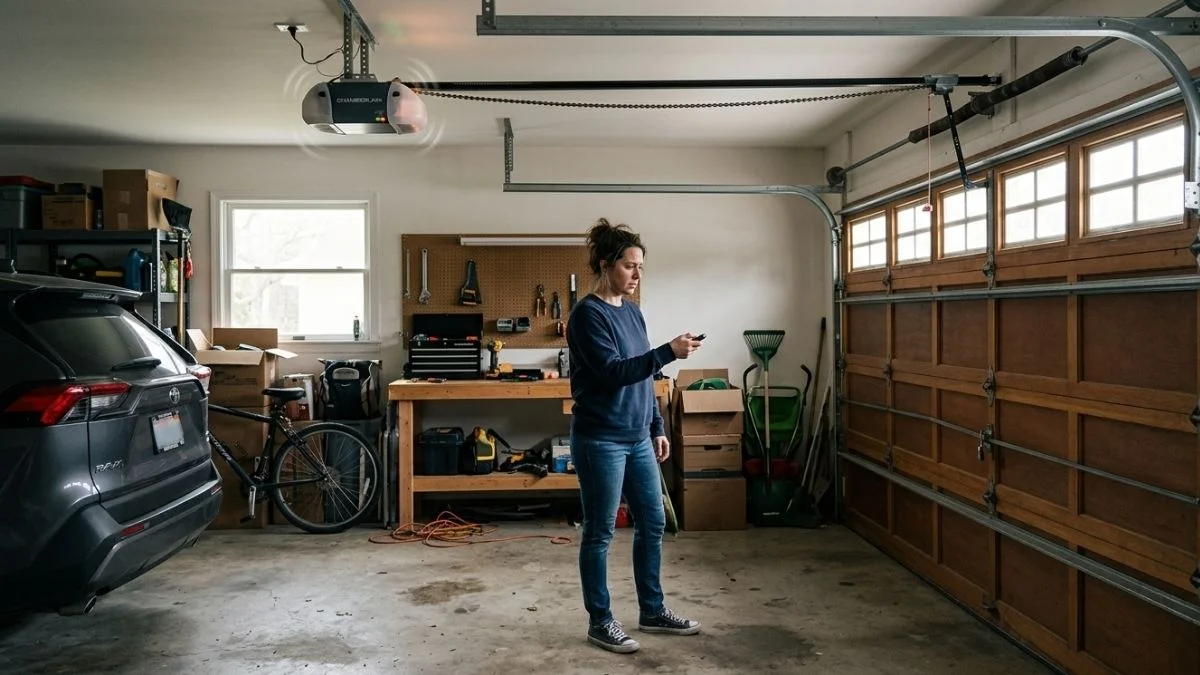
You press the button on your garage door remote, hear that familiar humming sound — and then nothing happens. The door doesn’t budge. It’s frustrating, especially when you’re running late or your car is stuck inside. But here’s the good news: a humming garage door opener doesn’t always mean an expensive repair or a full replacement.
That hum is actually your opener telling you something. The motor is receiving power, which rules out a dead electrical connection. The problem is somewhere in the mechanical or internal components preventing movement. In most cases, you can diagnose and fix this yourself with basic tools.
We cover the 7 most common reasons your garage door opener hums but won’t open — and exactly what to do about each one.
What Does It Mean When Your Garage Door Opener Hums But Won’t Open?
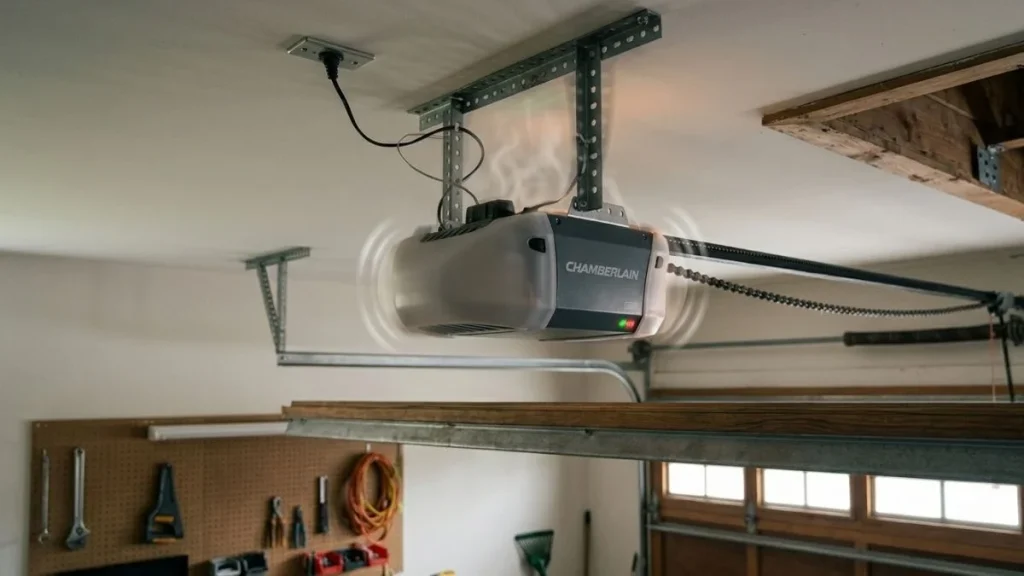
When your garage door opener hums, it means the motor is getting power and trying to run. But something — mechanical, electrical, or physical — is stopping it from doing its job. Think of it like pressing the gas pedal in a car that’s in park. The engine revs, but the car doesn’t move.
The humming sound is actually a helpful diagnostic clue. It rules out a dead power supply, a tripped circuit breaker, or a completely dead motor. That narrows down the problem significantly.
One thing to pay attention to is how long the hum lasts. A hum that stops after 2 seconds usually means the opener has a built-in thermal overload protection that kicks in to prevent damage. A continuous hum that doesn’t stop is a sign you should unplug the unit immediately to avoid overheating the motor.
Before you start troubleshooting, pull the red emergency release cord hanging from the trolley rail. This disconnects the door from the opener mechanism and lets you open and close the door manually. If the door moves smoothly by hand, the problem is with the opener itself. If the door feels extremely heavy or won’t move at all, a broken spring is likely involved.
Is It Safe to Keep Pressing the Button?
No — and this is important. Repeatedly pressing the remote or wall button when the opener is humming and not moving puts extra heat and strain on the motor. If the motor overheats, you could end up turning a $40 repair into a full motor replacement. If you hear a continuous hum, disconnect the power to the opener right away and start troubleshooting from there.
7 Reasons Your Garage Door Opener Hums But Doesn’t Work
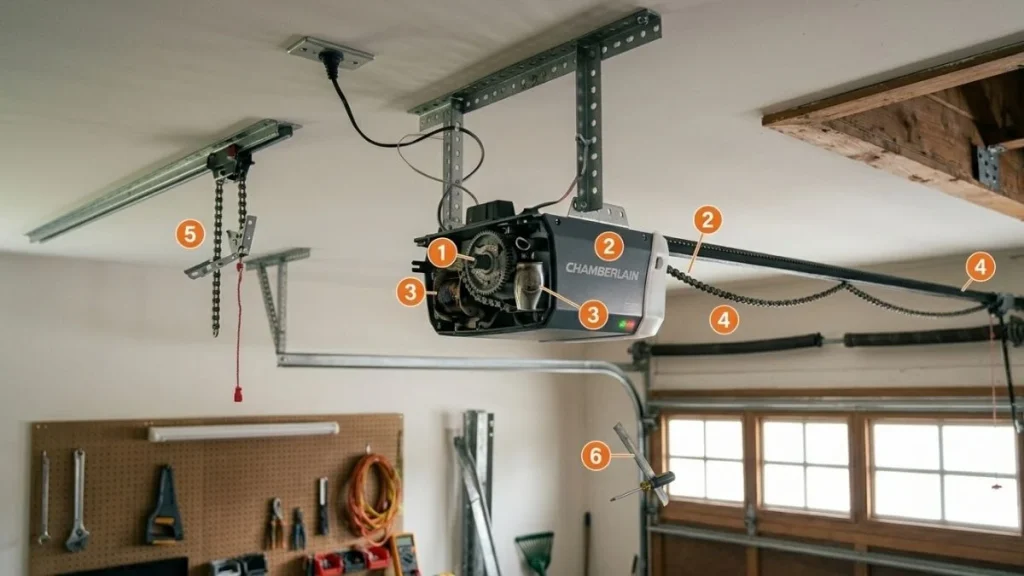
1. Stripped or Broken Drive Gear
This is the single most common cause of a humming garage door opener that won’t move. Inside most chain-drive and screw-drive openers, there’s a small plastic gear that transfers motion from the motor to the drive mechanism. Over time, this gear wears down or strips completely — especially if the door has been running without regular lubrication.
When the gear is stripped, the motor spins freely (causing the hum) but can’t engage the drive to move the door. If you open the opener housing and find white or gray plastic shavings inside, that’s a dead giveaway.
Signs your drive gear is stripped:
- Grinding or clicking noise alongside the hum
- White plastic dust or shavings visible inside the opener unit
- The door was working fine, then suddenly stopped with no warning
- The motor clearly runs but there’s zero movement from the trolley
How to fix it: Replacement drive gears are inexpensive — typically $15 to $40 — and are widely available online. Make sure you buy a gear kit that’s compatible with your specific opener model (usually printed on the motor head). The repair involves opening the housing, removing the old gear, and installing the new one. It’s a moderate DIY job that takes about an hour. If you’re not comfortable with it, a technician can handle it quickly for around $75–$100 in labor.
2. Bad Capacitor
The capacitor is a small cylindrical component inside the opener that stores an electrical charge and delivers a jolt of power to start the motor spinning. Without that initial burst, the motor hums but never actually turns over.
Capacitors degrade over time, and openers that are 7 years or older are especially prone to this issue. The good news is that a bad capacitor is one of the cheapest repairs on this list.
Signs the capacitor is failing:
- The hum is strong and consistent, but the motor shaft doesn’t spin at all
- The opener worked intermittently for a while before stopping completely
- A faint burning or plastic smell coming from near the motor head
How to fix it: Replacement capacitors cost between $5 and $20 at most hardware stores. However, there’s an important safety step: capacitors hold an electrical charge even after the unit is unplugged. You must discharge the capacitor safely before handling it — touching a charged capacitor can deliver a painful shock. Match the replacement exactly by rating (microfarads and voltage, printed on the side of the old capacitor). If you’re not familiar with basic electrical components, this is worth handing off to a professional.
3. Locked or Obstructed Door
Before you tear apart your opener, check the simplest possible explanation. Many homeowners have spent an hour troubleshooting only to discover the door was manually locked, frozen to the ground, or blocked by something in the track.
Quick checks to do first:
- Look for the manual lock bar on the inside of the door — it’s easy to accidentally engage
- In winter, check if the rubber bottom seal has frozen to the garage floor
- Inspect both tracks for debris, a bent section, or an object blocking the rollers
- Make sure nothing is blocking the safety sensor eyes near the floor (a blocked sensor can prevent the door from moving in one direction)
If the door was frozen to the ground, pour warm water along the bottom seal and wait a few minutes before trying again. Never force the door open — you risk damaging the bottom panel or tearing the seal.
4. Disconnected or Broken Trolley Carriage
The trolley carriage is the piece that rides along the rail and physically pulls the door up and down. It connects the door to the opener via a metal arm. If the trolley becomes disconnected — or if the carriage itself breaks — the motor will run and hum, but the door won’t move because there’s nothing connecting them.
This often happens when someone yanks the red emergency release cord at the wrong angle or with too much force. The cord is designed to disconnect the trolley for manual operation, but if it’s not reconnected properly afterward, the opener runs without being attached to the door.
How to reconnect the trolley: Pull the red emergency release cord toward the door (not straight down), then manually move the door to the open position. Once the door is up, the trolley carriage should snap back into the drive mechanism when you press the opener button. If the carriage is physically broken or cracked, you’ll need a full trolley replacement, which costs roughly $25–$60 for the part alone.
5. Weak or Failing Motor
Every motor has a lifespan. For garage door openers, that’s typically 10 to 15 years with regular use. As a motor ages, it may hum without generating enough torque to drive the door — especially on cold mornings when the grease in the mechanism is stiff.
A failing motor doesn’t always fail all at once. It often starts with the door moving slower than usual, then struggling on the way up, then eventually humming without moving at all.
Motor failure vs. other causes — how to tell the difference:
| Symptom | What It Suggests |
| Motor gets very hot during the hum | Dying motor or overloaded circuit |
| No movement even after checking all other components | Motor likely the culprit |
| Opener is 10–15+ years old | Motor age is a major factor |
| Everything else checks out fine | Motor replacement likely needed |
Repair vs. replace: Motor replacement parts can cost $80–$150, plus labor. At that point, it often makes more financial sense to invest in a brand new opener, especially since modern openers come with Wi-Fi connectivity, battery backup, and quieter belt-drive systems. A new opener typically runs $150–$300 for the unit, plus installation.
6. Tension Spring Issues
The torsion spring (or extension springs, depending on your door type) does the heavy lifting — literally. These springs counterbalance the weight of the garage door, so the opener only needs minimal force to move it. When a spring breaks, the door becomes dead weight, and the opener motor will hum under the strain and fail to move it.
A broken torsion spring is usually accompanied by a loud bang that sounds like a firecracker going off in the garage. If you heard that sound before the problem started, a broken spring is almost certainly the cause.
Warning signs of a broken spring:
- Loud bang heard from the garage before the opener stopped working
- The door feels extremely heavy or impossible to lift manually
- A visible gap in the torsion spring mounted horizontally above the door
- The door opens a few inches, then stops
Important safety warning: Do not attempt to repair or replace torsion springs yourself. These springs are under extreme tension — enough to cause serious injury or even death if mishandled. This is one repair where calling a licensed garage door technician is non-negotiable. Spring replacement typically costs $150–$350 including parts and labor, and a professional can complete it in under an hour.
7. Electrical or Wiring Issue
If you’ve worked through all the mechanical causes and the opener still just hums, the problem may be electrical — a loose wire connection, a power surge that damaged the logic board, or a faulty control board.
This is the least common cause, but it does happen — especially after a thunderstorm or power outage.
Basic electrical checks homeowners can safely do:
- Test the wall outlet by plugging in another device (a lamp or phone charger)
- Unplug the opener for 60 seconds and plug it back in to reset the logic board
- Look visually (without touching) at the wiring connections at the motor head for any obviously loose or burned wires
When to call a professional: If you notice a burning smell, scorch marks on the circuit board, or flickering lights on the opener unit, disconnect the power and call a technician. Logic board replacements cost $50–$100 for the part, but installation can be tricky depending on the model.
Step-by-Step Troubleshooting Guide — Where to Start
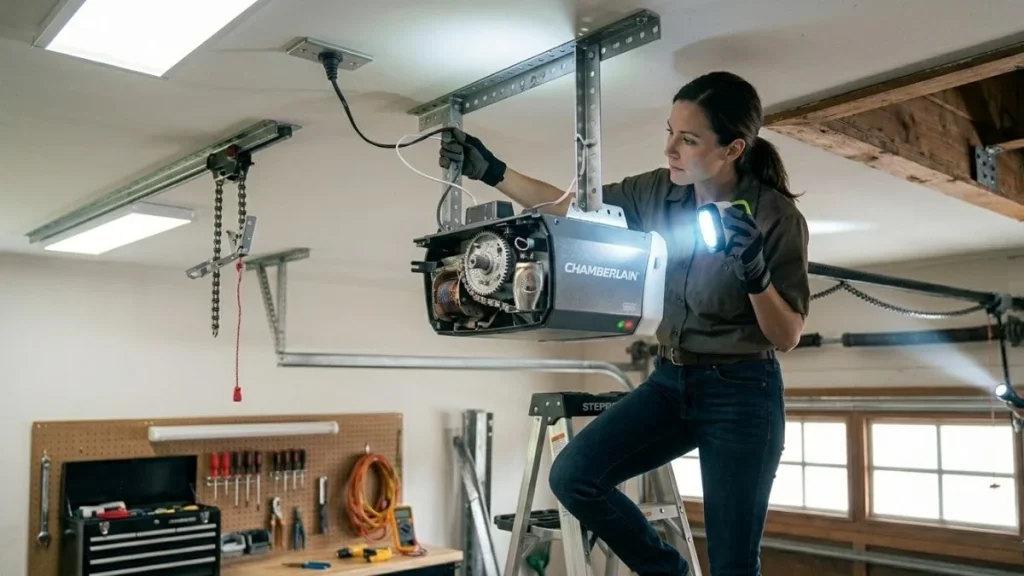
The best approach is to start simple and work toward the more complex. Here’s a logical diagnostic sequence:
Step 1: Check if the door is physically locked, frozen, or blocked in the tracks.
Step 2: Pull the red emergency release cord and try opening the door manually. Smooth movement? The door itself isn’t the problem.
Step 3: Check if the trolley carriage is properly connected to the drive.
Step 4: Open the opener housing and look for plastic shavings (stripped gear) or smell for burning (capacitor or motor).
Step 5: Check your opener’s age. 10+ years old? Motor wear is likely.
Step 6: Inspect the torsion spring above the door for a visible gap or break.
Step 7: If everything else checks out, reset the logic board by unplugging for 60 seconds.
When to DIY and When to Call a Professional

Most causes on this list are manageable for a handy homeowner. Clearing obstructions, reconnecting the trolley, and replacing a drive gear or capacitor are all reasonable DIY repairs with the right parts.
However, two situations always call for a professional: broken torsion springs and electrical repairs you’re not comfortable with. Torsion springs hold enough stored energy to cause serious injury — that’s not a risk worth taking to save $150.
Professional garage door repair typically runs $75 to $350 depending on the issue, and a good technician can diagnose and fix the problem in a single visit.
How to Prevent This Problem in the Future
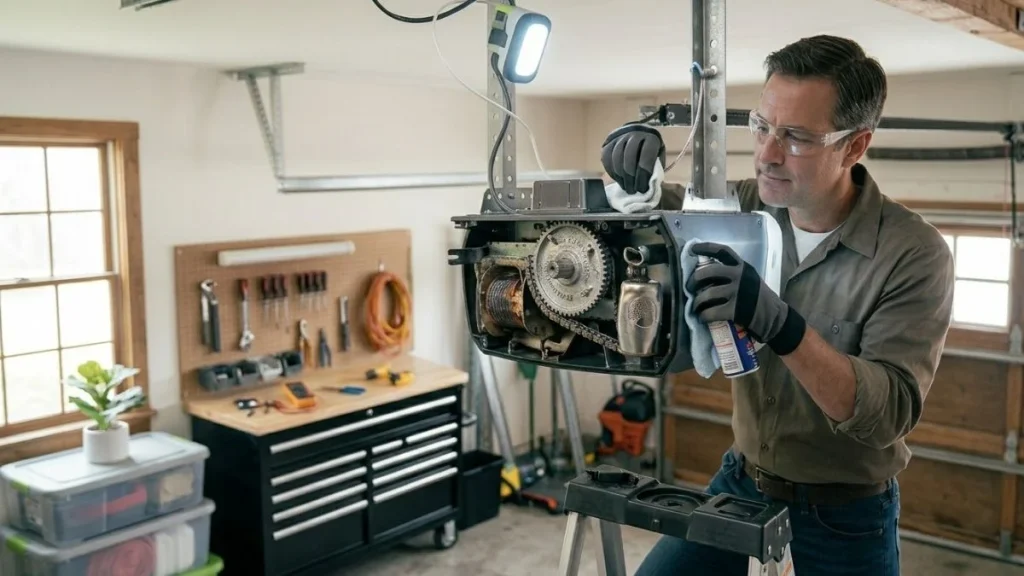
A little maintenance goes a long way. Lubricate the moving parts — rollers, hinges, and the torsion spring — every 6 to 12 months using a silicone-based spray or white lithium grease. Avoid WD-40; it’s a solvent, not a lubricant, and will dry out the components over time.
Test the door’s balance every few months by disconnecting the opener and manually lifting the door halfway. It should stay in place on its own. If it drops or shoots up, the spring tension needs adjustment.
Pay attention to early warning signs — slower operation, grinding noise, or the door reversing unexpectedly — and address them before they turn into a full breakdown. If your opener is approaching the 10 to 15 year mark, consider a proactive replacement before it fails at the worst possible moment.
You May Read Also: How To Reset MyQ Garage Door Opener
Conclusion
A garage door opener that hums but won’t move is rarely the end of the road. In most cases, it comes down to one of seven fixable causes: a stripped drive gear, bad capacitor, locked or obstructed door, disconnected trolley, worn motor, broken spring, or an electrical fault.
Start with the simple stuff — check for obstructions, reconnect the trolley, and look inside the housing for obvious wear. Most homeowners can resolve this in an afternoon without spending much money.
That said, know your limits. Broken torsion springs are dangerous and should always be handled by a licensed professional. A $200 repair call is far cheaper — and safer — than a DIY mistake on a high-tension spring.


