
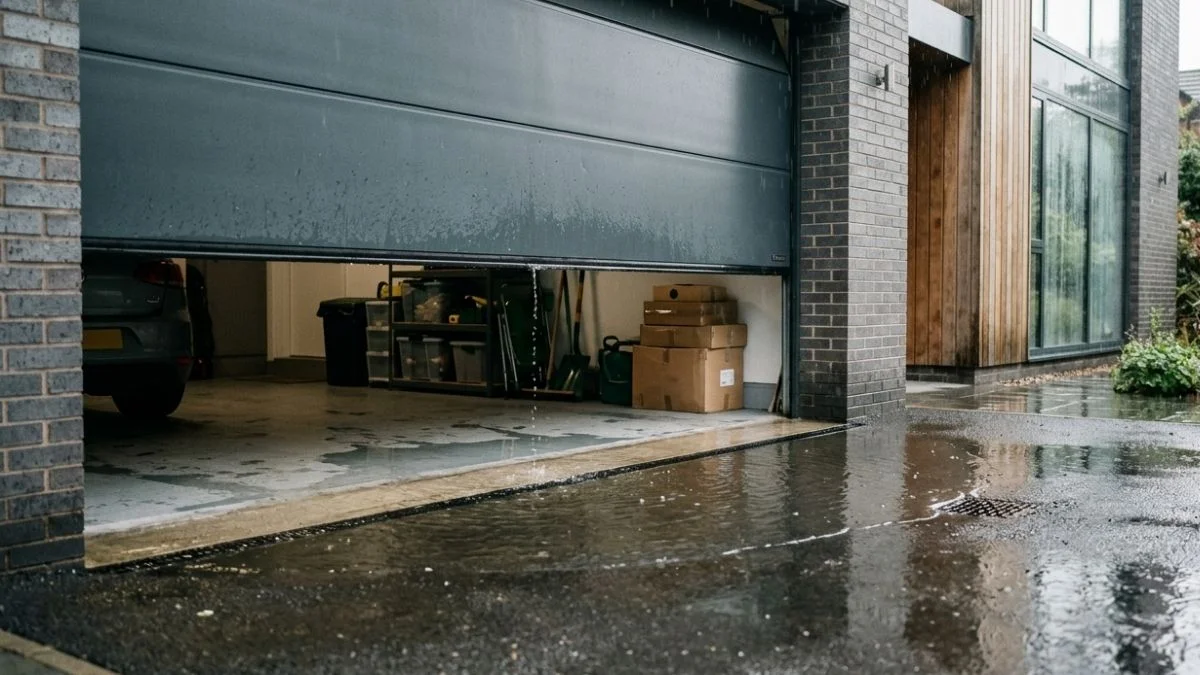
A garage door that leaks at the bottom is one of the most common water intrusion complaints homeowners report, yet most cases trace back to just a handful of fixable problems.
The real frustration is not knowing whether you are dealing with a $15 weatherstrip replacement or a drainage issue that requires regrading your driveway — and making the wrong call wastes both time and money.
This guide walks you through 6 specific causes of garage door bottom leaks, how to diagnose which one applies to your situation, and exactly what it takes to fix each one — including when the job genuinely needs a licensed contractor.
Why Water Leaks Under Your Garage Door
Water leaking under a garage door comes from 5 distinct failure points. Most homeowners assume the bottom seal is always the culprit — but the actual source is often somewhere else entirely.
Poor or Degraded Bottom Seal
The bottom seal is a rubber or vinyl strip attached to the door’s lowest panel. UV exposure and seasonal temperature swings cause it to harden, crack, and flatten over time, breaking the contact it needs with the floor to block water. When that contact disappears, even light rain finds a path straight through.
Damaged Weather Stripping and Side Seals
Water doesn’t always travel straight down. During heavy rain, it tracks along the door frame’s edges before pooling at the bottom. Deteriorated side seals and top weather stripping allow that lateral infiltration — meaning you can replace the bottom seal perfectly and still see water intrusion if the frame seals are ignored.
Driveway Sloping Toward the Door
This is the most overlooked cause of rain coming under a garage door. Concrete settling or improper grading funnels surface runoff directly toward the threshold. Gutter overflow or a misrouted downspout discharging near the door compounds the problem by concentrating high water volume at a single entry point.
Inadequate Garage Floor Drainage
A flat or slightly inward-sloping garage floor traps water against the door instead of shedding it away. An existing floor drain or French drain system may be clogged, undersized, or positioned too far from the threshold to intercept incoming water.
Unbalanced Garage Door
A door with worn springs or damaged tracks doesn’t hang level. The result is visible gaps at one or both bottom corners — gaps that no weatherstrip replacement will fix until the door balance and alignment are corrected first.
Diagnosing Your Specific Leak
Before buying any parts or hiring anyone, spend 15 minutes on a dry day running through this inspection. The leak pattern and physical condition of each component will point you directly to the cause.
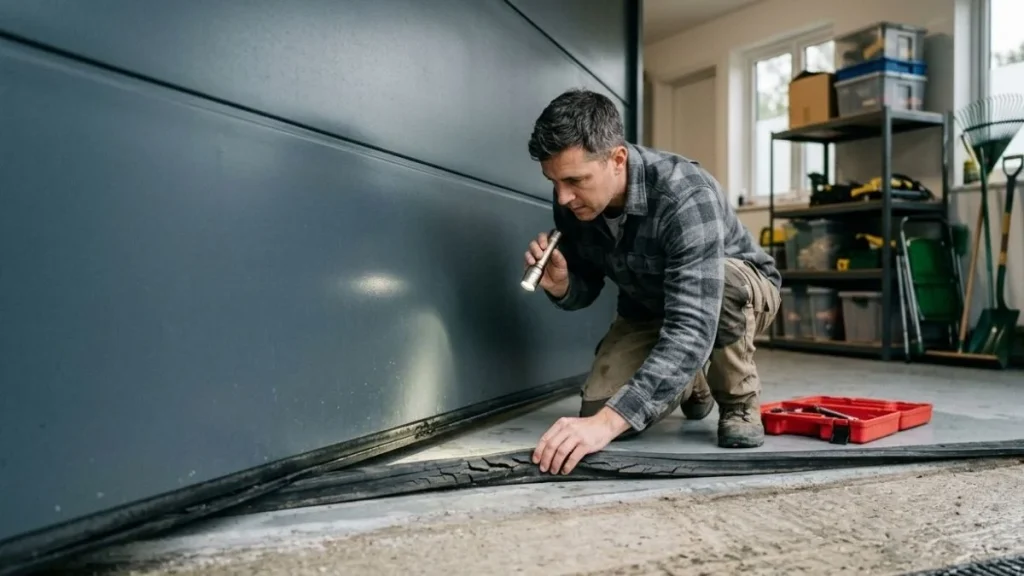
Visual Inspection Checklist
Work through these four checks in order:
- Bottom seal: Run your hand along the full width of the seal. Cracks, hardened sections, missing chunks, or areas that no longer lie flat against the floor all indicate bottom seal degradation requiring replacement.
- Side seals and top weather stripping: Look for tears, compression loss, or gaps where the seal pulls away from the door frame. Pay attention to the lower corners — that’s where side seal failure most often shows up as water intrusion.
- Driveway slope: Water should flow away from the door, not toward it. A proper driveway grade slopes away at a minimum of 1/8 inch per foot. Use a 4-foot level and a tape measure to check. If water flows toward the threshold, poor drainage grading is a primary suspect.
- Hose test: Run a garden hose at the top of your driveway and watch where the water travels. If it channels directly toward the garage threshold, you have confirmed a grading or drainage problem independent of any seal condition.
Leak Pattern Clues
Where water appears inside the garage tells you as much as the physical inspection.
Water pooling across the full center width of the doorway points to bottom seal failure — the seal has lost contact with the floor uniformly. Water appearing only at one or both corners indicates a side seal problem or an unbalanced door creating localized gaps.
Leaks that only occur during heavy rain suggest a threshold or weatherstripping issue that normal moisture can’t overcome but high volume can. Leaks that worsen dramatically during spring snowmelt or sustained rainfall — regardless of rain intensity — point toward drainage grading as the primary cause, since water is accumulating faster than the ground can absorb it.
DIY Fixes You Can Try First
Four of the 6 causes are genuinely DIY-friendly with basic tools and hardware store parts. Two are not — and attempting them without the right equipment creates safety risks that outweigh the cost savings.
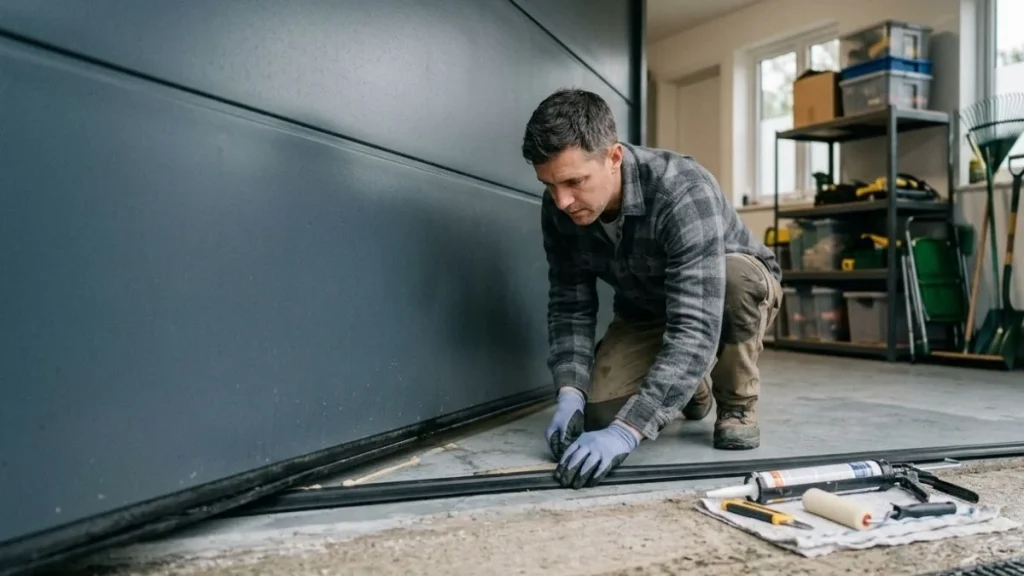
Low-Cost Solutions (Before Calling a Pro)
Start with the least invasive fixes and work up from there.
Clean and reseat the bottom seal. Dirt, gravel, and dried debris accumulate along the floor contact line and physically hold the seal off the surface. Sweep the threshold clean, wipe the seal with a damp cloth, and close the door. Check whether the gap disappears. This costs nothing and resolves the problem more often than homeowners expect.
Install a garage threshold seal kit. A threshold seal — brands like Garadry and M-D Building Products offer reliable options — is a rubber or vinyl strip you bond to the floor directly below the door. It raises the contact point by 1/2 to 3/4 inch, compensating for an uneven floor or a worn bottom seal. Kits run $50–$150 at Home Depot or Lowe’s and install with adhesive in under an hour.
Replace or reinforce side weather stripping. Self-adhesive foam or rubber weatherstripping tape applied to side frame gaps costs under $20 and stops lateral water tracking. For a more durable fix, replace the full side seal with a kerf-style or nail-on vinyl strip, which runs $10–$30 per side.
Apply concrete sealer to low driveway spots. Minor surface depressions that pool water near the threshold can be filled with a hydraulic cement or self-leveling concrete resurfacer before sealing. This is a practical fix for small grading issues without excavation.
When DIY Hits Its Limit
3 situations require professional intervention:
- Driveway regrading or French drain installation involves excavation, compaction equipment, and sometimes permits — well beyond standard DIY scope regardless of skill level.
- Integrated bottom seal replacement on doors where the seal threads through a retainer slot connected to the opener’s safety-reverse system requires disconnecting and recalibrating that system. Miscalibration causes the door to reverse unexpectedly or fail to detect obstructions.
- Unbalanced door correction involves adjusting torsion springs under extreme tension. According to the International Door Association, torsion spring injuries send thousands of homeowners to emergency rooms each year — this is one task where professional service is the correct call.
Repair vs. Replace: Cost and Timeline
The right fix depends on how far the damage has progressed and what’s actually causing the leak. Spending $150 on a new bottom seal when the real problem is driveway grading means you will be back to square one after the first heavy rain.
When the Bottom Seal Is Beyond Saving
A bottom seal needs replacement — not cleaning — when it shows any of these conditions:
- Visible cracks running through the full thickness of the rubber
- Sections that have torn away or are missing entirely
- Hardening so severe the seal no longer flexes when compressed by hand
- Permanent flat spots where the seal no longer returns to its original profile
At that point, reseating or cleaning will not restore contact. Professional garage door bottom seal replacement typically costs $75–$200 in labor plus $15–$50 for the seal material itself, depending on door width and seal type.
Threshold Kit vs. Full Seal Replacement
A garage threshold seal kit at $50–$150 installed DIY often delivers the same weatherproofing result as a professional seal replacement at $90–$250 — and it compensates for minor floor unevenness that a new bottom seal alone cannot fix. For most homeowners with a moderately worn seal and a reasonably level floor, the threshold kit is the higher-value first move.
When Driveway Regrading Earns Its Cost
Repeated seal replacements every 2–3 years are a signal that water volume at the threshold exceeds what any seal can handle. Driveway regrading or French drain installation runs $500–$3,000 depending on scope, but it eliminates the root cause permanently. That ROI becomes clear after the second or third seal replacement cycle.
Realistic Labor Timelines
| Fix | DIY Time | Pro Time |
|---|---|---|
| Clean and reseat seal | 20–30 minutes | N/A |
| Threshold kit installation | 45–90 minutes | 1 hour |
| Bottom seal replacement | 1–2 hours | 30–60 minutes |
| Side weather stripping replacement | 30–60 minutes | 30 minutes |
| Driveway regrading / French drain | Not recommended | 1–3 days |
Keep Leaks From Coming Back
A single repair stops the current leak. A maintenance routine prevents the next one. Three annual tasks cover the majority of recurring garage door water intrusion problems.
Inspect Seals Before Each Rainy Season
Check the bottom seal, side seals, and top weather stripping twice a year — once in early spring before heavy rain season and once in late fall before freezing temperatures arrive. Freezing accelerates bottom seal degradation faster than UV exposure alone, because water trapped in micro-cracks expands and widens them with each freeze-thaw cycle.
Run the same visual checklist from the diagnosis section: look for cracking, hardening, separation, and compression loss. A seal caught at early hardening can be treated with a silicone-based rubber conditioner — a product like 303 Aerospace Protectant slows UV degradation and extends seal life by keeping the rubber flexible. Replacing a seal at the first sign of failure costs far less than addressing structural water damage after a season of unchecked intrusion.
Manage Gutters and Downspout Positioning
A clogged gutter directly above the garage door turns moderate rain into a concentrated waterfall at the threshold. Clean gutters at least twice a year — spring and fall — and confirm that downspout extensions discharge water at least 4 feet away from the garage foundation. A $10–$20 downspout extender from any hardware store eliminates one of the most common causes of high-volume water intrusion that overwhelms an otherwise functional seal.
Monitor the Driveway for Settling and Cracks
Concrete driveways shift, settle, and crack over time — and even a 1/4-inch depression near the threshold creates a water channel that feeds directly under the door. Walk the driveway every 2–3 years with a critical eye toward slope direction and new surface cracks. Fill hairline cracks with a concrete crack filler like Quikrete Polyurethane Concrete Crack Sealant before they widen. Catching a grading problem early — before it requires full regrading — keeps moisture control manageable at the DIY level.
Read Also: Water Damage on Your Garage Ceiling?
Quick Answers
How Do I Know If My Garage Door Leak Is Normal?
No amount of water intrusion under a properly maintained garage door is normal. A correctly installed bottom seal, intact side weather stripping, and a driveway sloped away from the threshold should keep the garage floor dry in all but the most extreme flooding events. If you are seeing any standing water inside the garage after rain, something has failed or was never correctly installed. Treat it as a fixable problem, not an expected condition.
How Much Does a Professional Bottom Seal Replacement Cost?
Professional garage door bottom seal replacement costs $75–$250 total for most single-car doors, and $150–$350 for two-car doors, depending on seal material, door width, and local labor rates. The seal material itself — a rubber or vinyl T-style or bulb-style strip — costs $15–$50. The rest is labor, which typically takes a technician 30–60 minutes. Getting a threshold seal kit installed at the same visit adds $50–$100 to the total but significantly improves the weatherproofing result.
What’s the Fastest Temporary Fix While I Plan a Real Solution?
A rolled bath towel or a draft stopper placed along the interior base of the door stops water from spreading across the garage floor immediately. For a more functional short-term fix, a self-adhesive foam weatherstrip tape applied directly to the bottom seal’s floor contact surface adds a compressible layer that restores temporary contact. Neither solution replaces a proper garage threshold seal or bottom seal replacement, but both protect your floor and belongings while you arrange the permanent repair.
Next Steps
The leak pattern and a 15-minute visual inspection tell you almost everything you need to know before spending a dollar. Start there today — check your bottom seal, side weather stripping, and driveway slope using the checklist in the diagnosis section, then match what you find to the corresponding fix. If the seal is worn and the driveway slopes toward the door, install a Garadry or M-D Building Products threshold kit first — it costs under $150 and resolves both problems in a single step.