

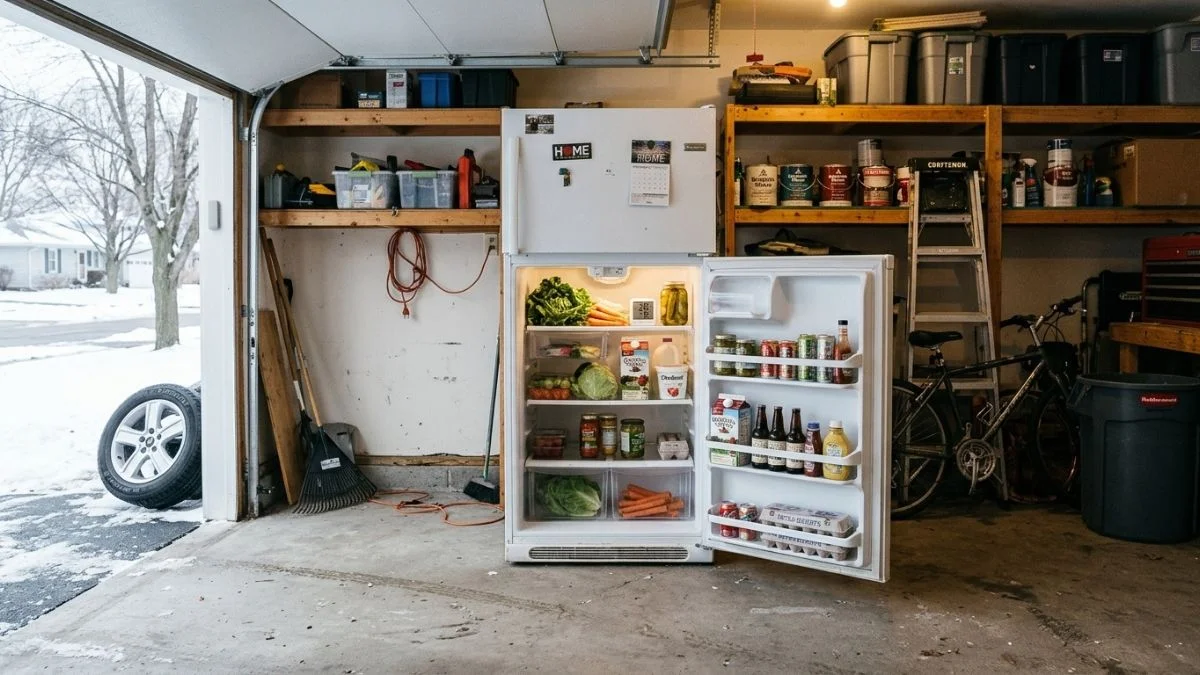
Most homeowners don’t realize that knowing how to keep a garage refrigerator from freezing is just as important as keeping it cold — and Whirlpool’s official documentation warns that refrigerators operate unreliably below 50°F ambient temperature.
When garage temps drop into the 30s, the fridge’s thermostat reads the surrounding air as already cold enough, stops cycling, and your food freezes solid despite normal settings.
This guide covers 7 practical fixes — from free thermostat adjustments to affordable heating solutions — so your garage fridge protects food reliably all winter.
Why Garage Refrigerators Freeze in Winter
Garage refrigerators freeze food in winter because the appliance’s thermostat measures the wrong temperature. Here’s the problem in plain terms: the thermostat senses the cold garage air, decides the fridge is already at target temperature, and stops cycling the compressor. The fresh food compartment then drops well below 37°F — the standard safe zone — and your lettuce turns to ice.
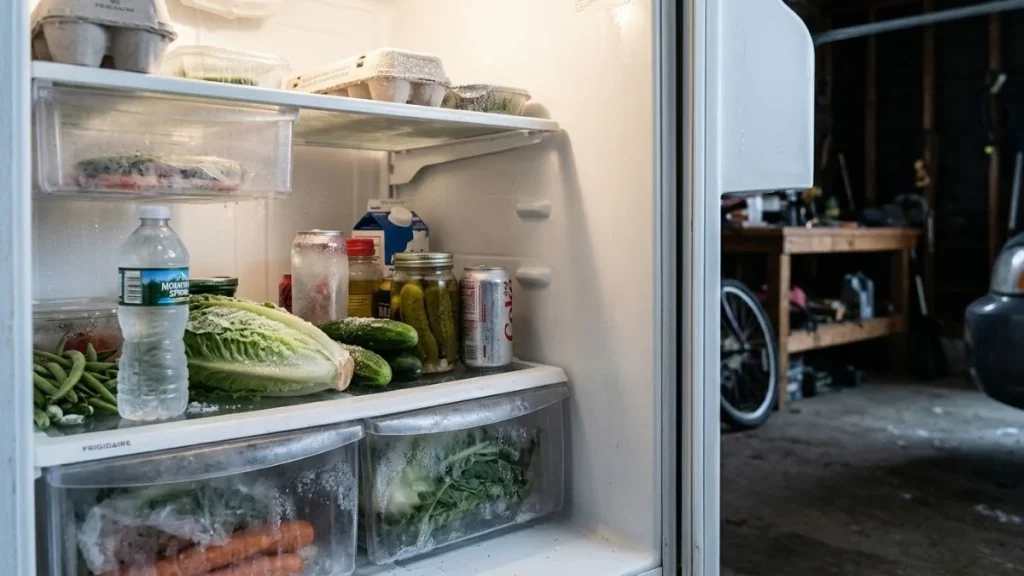
The Thermostat Reads Ambient Air, Not Food Temperature
A standard refrigerator thermostat is calibrated for indoor kitchen conditions, typically 60°F–90°F ambient temperature. When unheated garage refrigerator management becomes necessary in winter, that calibration works against you. At ambient temperatures below 50°F, the thermostat interprets the surrounding cold air as sufficient cooling and undercuts the refrigeration cycle entirely. This is a classic appliance thermostat calibration failure — not a mechanical breakdown, just a design mismatch between indoor appliances and outdoor environments.
The Freezer Compartment Makes It Worse
Most refrigerator-freezer combos share a single cooling system. The freezer compartment pulls cold air through dampers into the fresh food section. When garage air drops into the 30s, that temperature gradient between inside and outside collapses, and cold air floods the fresh food zone continuously. Prevent food freezing in cold garage situations requires understanding this cross-compartment dynamic — the freezer is essentially over-contributing cold air with no thermostat correction to compensate.
Continuous Compressor Cycling Expands the Problem
In milder cold, the compressor cycles on and off normally. Below 40°F ambient, the refrigeration cycle can become erratic — running too long, too short, or not at all. This disrupts thermal management across both compartments, pushing temperatures into unsafe territory in both directions: freezing fresh food while potentially letting freezer temps rise. Garage refrigerator winterization addresses all three of these failure points simultaneously.
Minimum Safe Operating Temperature for Garage Appliances
Most residential refrigerators are designed to operate within a 60°F–90°F ambient range — and that single fact explains most garage freezing problems. GE, Whirlpool, and LG all publish minimum operating temperature guidelines in their product documentation, and all three land in the 50°F–60°F floor range depending on the model.
What the Manufacturers Actually Specify
Whirlpool specifies a minimum ambient temperature of 55°F for most of its refrigerator-freezer models. GE lists 60°F as the lower operating limit for standard models, though some garage-ready units extend down to 38°F. LG similarly recommends a minimum of 50°F for reliable garage refrigerator temperature control. Below these thresholds, ambient temperature regulation falls outside the design parameters of the appliance — and the thermostat has no reliable reference point.
What Happens Below 50°F
Below 50°F, two things happen simultaneously. The compressor runs erratically, disrupting the normal refrigeration cycle. At the same time, the fresh food compartment loses its thermal management buffer and begins dropping toward freezer-level temperatures. The result is a broken appliance thermostat calibration loop — the fridge can’t maintain the 35°F–38°F target range it was built to hold.
Symptoms to Look For
Unheated garage refrigerator management starts with recognizing the warning signs:
- Ice crystals forming on lower shelves or produce drawers
- Vegetables freezing solid, especially leafy greens and cucumbers
- Butter hardening to a brick-like consistency in the fresh food section
- Beverages in the door bins partially freezing
- Unusual silence from the compressor during cold snaps
If you’re seeing two or more of these symptoms, your garage ambient temperature has almost certainly dropped below the manufacturer’s minimum — and the fixes in the next section apply directly to your situation.
Simple No-Cost and Low-Cost Fixes
Three of the most effective garage refrigerator winterization solutions cost nothing — or less than $20. Start here before buying any specialized equipment.
Thermostat Dial Adjustment
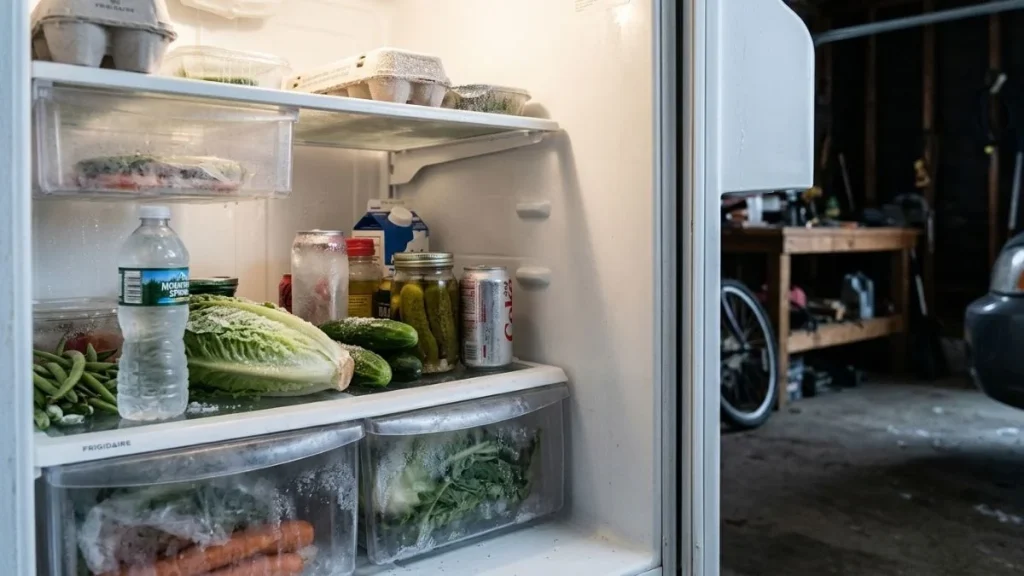
This is the first fix to try. Turning the thermostat dial toward a warmer setting tells the appliance to cycle less aggressively, which reduces the risk of the fresh food compartment overcooling. For thermostat adjustment for garage fridge situations, move the dial one notch warmer than your current setting, then wait 24 hours and check food temperatures with an inexpensive refrigerator thermometer. The target range is 35°F–38°F in the fresh food section. This costs nothing and takes 30 seconds.
Interior Heat Source: The Incandescent Bulb Hack
A 40W or 60W incandescent bulb placed inside the refrigerator cavity generates enough residual heat to counteract mild ambient temperature drops. The warmth raises the internal air temperature just enough to keep the thermostat cycling normally — restoring proper thermal management without any modifications to the appliance itself. This approach works reliably when garage temperatures stay above 40°F. Below that threshold, a single bulb typically can’t generate sufficient heat to compensate for the temperature gradient. Total cost: under $20 for a bulb and plug-in timer. Note that LED bulbs produce almost no heat, so an incandescent is essential here.
Door Switch Bypass or Adjustment
The door switch — the small button the door depresses when closed — controls the interior light and, on some models, signals the defrost cycle. A loose or misaligned switch can trigger false open-door signals, causing unnecessary defrost cycles that disrupt appliance thermostat calibration and contribute to freezing. Open the door, locate the switch on the door frame, and press it manually. If it feels loose or doesn’t click cleanly, reseat it firmly. No tools required in most cases.
Insulation and Garage Environmental Control
Fixing the fridge itself only solves half the problem. The other half is controlling the garage environment so ambient temperature regulation keeps the appliance inside its operating range.
Weatherization First
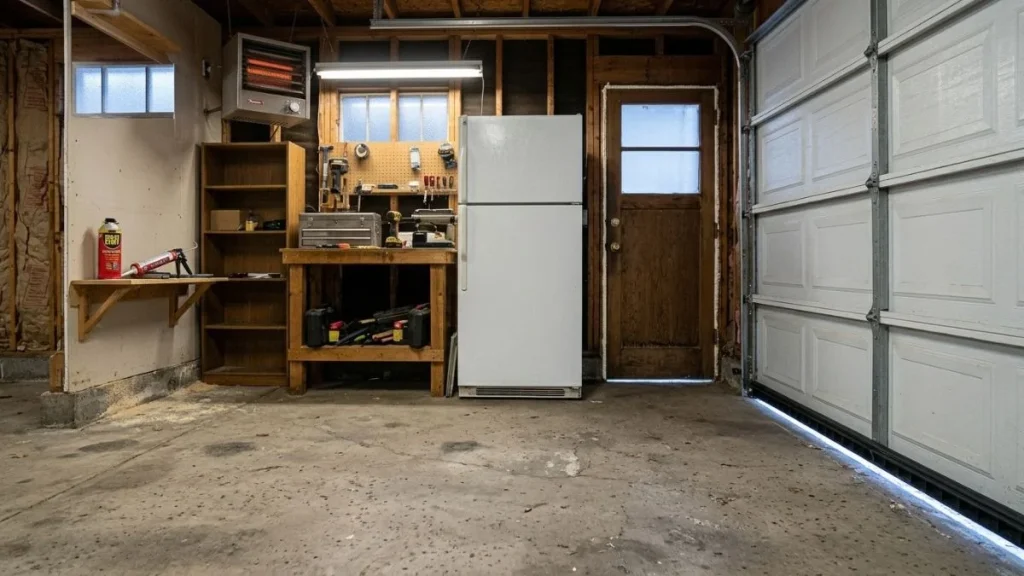
Cold weather appliance insulation starts with the garage itself, not the refrigerator. Drafts entering through gaps around the garage door, windows, and wall penetrations can drop the localized temperature around your fridge by 10°F–15°F below the general garage air temperature — creating a microclimate the appliance was never designed to handle.
Effective weatherization targets three areas:
- Garage door bottom seal: Replace worn rubber seals; a degraded seal is the single largest source of cold air infiltration
- Door frame weatherstripping: Press new foam or rubber strip along all four sides of the garage entry door
- Wall gaps and penetrations: Use expanding spray foam around pipe entries, electrical conduits, and any visible gaps
According to the U.S. Department of Energy, proper weatherization can reduce heating load by up to 30% in attached garages. Total material cost typically runs $50–$200 depending on garage size.
Space Heater or Thermostat-Controlled Heating System
When weatherization alone isn’t enough, a dedicated garage heater maintains the 50°F–55°F minimum that most manufacturers require. Units like the Dr. Infrared Heater DR-988 or Fahrenheat FUH54 are purpose-built for unheated garage refrigerator management scenarios. Upfront cost ranges from $100–$600 depending on output and installation requirements, with monthly operating costs of $15–$40.
The key feature to prioritize is a built-in thermostat. Thermostat-controlled models activate only when garage temperature dips below a set point, making them far more efficient than units running continuously. Set the trigger at 50°F and the heater handles ambient temperature regulation automatically — without any daily intervention from you.
Maintenance and Thermostat Calibration
A garage fridge working harder than it should in cold weather exposes every maintenance weakness. Two components fail most often in winter: condenser coils clogged with dust and thermostats that have drifted out of calibration.
Condenser Coil Maintenance
Condenser coils release heat from the refrigeration cycle into the surrounding air. When they’re coated in dust and debris — which happens faster in garages than kitchens — the coils can’t dissipate heat efficiently. The compressor compensates by running longer cycles, which destabilizes thermal management across both compartments and worsens freezing in the fresh food section.
Clean the coils quarterly during winter months. The process takes under 15 minutes:
- Unplug the refrigerator completely
- Locate the coils — on most models they’re behind the kickplate at the bottom front, or at the back of the unit
- Use a coil cleaning brush (Frigidaire and GE both sell compatible brushes for under $15) to loosen debris
- Vacuum the loosened dust with a narrow attachment
- Plug the unit back in and monitor temperature for 24 hours
Garage environments introduce more dust, sawdust, and particulate matter than kitchens, making quarterly condenser coil maintenance essential — not optional.
Thermostat Testing and Replacement
A worn thermostat misreads internal temperature and disrupts appliance thermostat calibration even when everything else is functioning correctly. Before replacing it, test the existing unit. Place a calibrated refrigerator thermometer — the Taylor 5924 is a reliable, widely available option — in the center of the fresh food section and compare its reading to the thermostat’s set point after 8 hours.
A variance of more than 5°F indicates a failing thermostat. Replacement thermostats for most common brands run $50–$150 and are available through Repair Clinic or Amazon. Match the part number to your model exactly — a mismatched thermostat creates the same garage refrigerator temperature control problems you’re trying to solve.
Frequently Asked Questions
Why does my garage fridge freeze food even with the thermostat set normally?
The thermostat senses cold garage air — not food temperature — and stops cycling the compressor, causing the fresh food compartment to drop below 37°F. This happens because standard refrigerators are calibrated for 60°F–90°F indoor environments, not unheated garages.
Can I keep a refrigerator in an unheated garage during winter?
Yes, but only if you take active steps to compensate for low ambient temperatures — such as thermostat adjustment, an interior heat source, or a garage heater set to maintain at least 50°F. Without intervention, any garage dropping below 50°F will cause unreliable performance in most standard refrigerator models.
What’s the cheapest solution: heater, insulation, or thermostat adjustment?
Thermostat adjustment costs nothing and should always be the first step. If that alone doesn’t stabilize food temperatures, add a 40W–60W incandescent bulb inside the cavity for under $20. Weatherization and garage heaters deliver more reliable long-term results but cost significantly more — $50–$600 depending on the approach.
At what temperature does a garage fridge stop working properly?
Most models from GE, Whirlpool, and LG begin operating unreliably below 50°F–60°F ambient temperature. Below 35°F, food freezing in the fresh section is nearly guaranteed without a compensating heat source or garage-ready appliance.
Keep Your Garage Fridge Winter-Ready
No single fix works for every garage — the right solution depends on how cold your space gets and how much you want to spend. Start today by adjusting the thermostat one notch warmer and placing a refrigerator thermometer inside the fresh food section to get a real temperature baseline. That reading tells you exactly which of the 7 solutions your situation actually requires.