

A double hung window top sash that won’t stay up is more than an annoyance — it’s a sign that the balance system holding it in place has failed, and left unfixed, it creates a security gap and drives up energy bills.
The problem is that most homeowners don’t know whether the culprit is a worn balance shoe, a broken spiral balance, or a damaged jamb liner — and without that diagnosis, every fix is a guess.
This guide walks you through identifying the exact cause and executing the right repair, so you can confidently fix the problem yourself or know precisely when to call a professional.
How Double-Hung Window Balance Systems Work
A double-hung window stays in place — at any height — because a balance mechanism counteracts the weight of the sash. When that mechanism fails, the upper sash drops immediately, because nothing is holding it up.

Spring Balances vs. Sash Cord Systems: Which Do You Have?
There are two main balance systems found in residential double-hung windows.
Spring balances are standard in virtually all vinyl and modern wood windows made after the 1980s. A metal spiral or flat ribbon spring runs inside a narrow channel in the jamb liner — the plastic or metal track the sash slides within. The spring attaches to a balance shoe at the bottom of the channel and connects to the sash via a tilt pin, a small pivot point built into the corner of the sash frame. Tension in the spring is what holds the upper sash in position.
Sash cord systems are found in older wood windows, typically pre-1960 construction. A woven cotton or nylon cord runs over a pulley mounted at the top of the jamb and connects to a cast-iron counterweight hidden inside the wall cavity. Sash cord tension adjustment is possible, but these systems fail when cords fray or break.
Why the Upper Sash Drops When Balance Fails
The moment spring tension is lost — whether from a snapped spring, a dislodged balance shoe, or a broken tilt pin — the upper sash has no upward force counteracting gravity. It drops. There is no friction mechanism or locking point to catch it mid-travel. This is why window balance replacement is the fix, not a temporary adjustment.
Diagnosing Why Your Top Sash Won’t Stay Up
Before replacing any window hardware, spend five minutes on diagnosis. The symptom — upper sash dropping — has three distinct causes, and each requires a different fix.

Visual Inspection Checklist
Start with the sash in the closed position. Check these 4 components in order:
- Tilt pins: Look at the top corners of the upper sash. The tilt pins should be seated inside the balance shoe slots on both sides. A pin that has popped out of its slot will cause an immediate, one-sided drop.
- Balance shoes: Slide the upper sash down about six inches and look into the jamb liner channel on each side. The balance shoe — a small plastic or metal clip — should be visible and level. A shoe that has slid to the bottom of the channel means spring tension is gone.
- Springs: On spiral spring balance systems, look for a visibly unwound or kinked metal rod inside the jamb liner channel. A broken spring offers zero resistance.
- Sash cords: On older pulley systems, inspect the cord where it attaches to the sash sides. Fraying or a clean break confirms the cause immediately.
Testing Balance Mechanism Resistance
With the upper sash tilted inward slightly, press upward on it with one hand. A functioning spring balance offers noticeable, consistent resistance. No resistance at all points to a failed spring or completely disengaged balance shoe.
Symptom-to-Cause Decision Tree
| Symptom | Likely Cause |
|---|---|
| Sash drops on one side only | Tilt pin disengaged or broken |
| Sash drops straight down, no resistance | Failed spring balance on both sides |
| Sash drops slowly with cord visible | Frayed or broken sash cord |
| Balance shoe visible at bottom of channel | Spring tension lost, shoe needs repositioning or replacement |
Three Fixable Causes and Their Solutions
Each fix below matches one cause from the diagnostic section. Work through only the one that matches your symptom.
Fix 1: Re-Engage or Replace the Tilt Pin
The tilt pin sits at the top corner of the upper sash and locks into the balance shoe slot inside the jamb liner. When it pops out — usually after the sash is tilted inward for cleaning and not fully reset — the sash loses support on that side.
Steps:
- Tilt the upper sash inward by pressing the top corners toward you.
- Lift the sash fully out of the jamb liner channel.
- Inspect both tilt pins. A worn or broken pin will show visible cracking or a flat, compressed tip.
- If the pin is intact, reseat the sash by aligning both pins with the balance shoe slots and pressing firmly until you feel them click into place.
- Replace damaged pins with manufacturer-matched hardware — Andersen and Pella both sell tilt pin kits for under $20.
Cost and difficulty: $5–$20, approximately 30 minutes, low skill required.
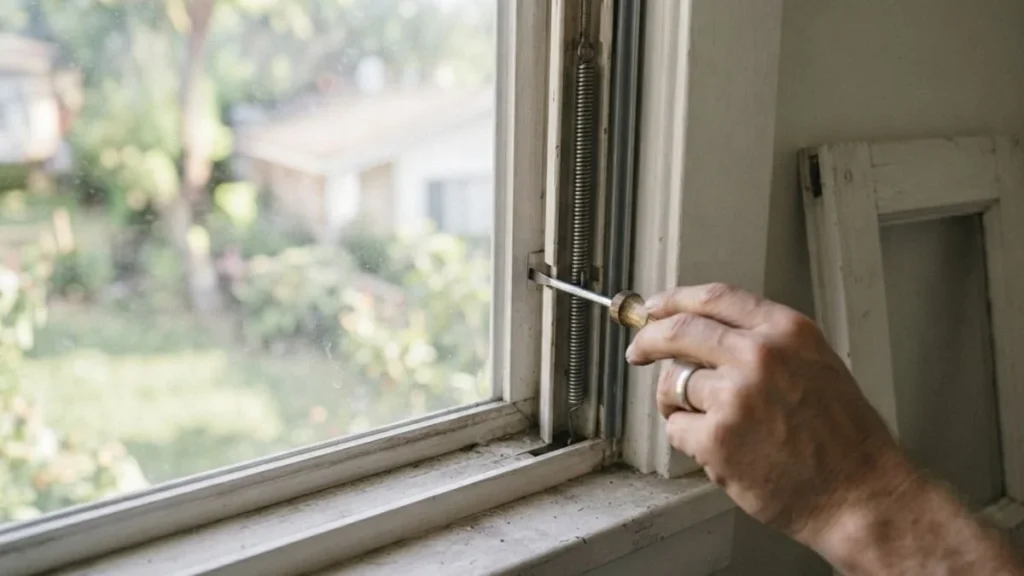
Fix 2: Restore Spring Balance Tension or Replace the Spring
A double hung window spring balance loses tension in two ways: the spring unwinds fully, or the internal mechanism breaks. Tension adjustment is only possible if the spring is intact but slack.
Steps:
- Remove the upper sash using the tilt-in method.
- Locate the spiral balance rod inside the jamb liner channel.
- Use a flat-head screwdriver to wind the spiral rod clockwise — typically 3 to 5 full turns restores working tension on a slack spring.
- Reseat the sash and test. If the sash still drops, the spring is broken and needs full window balance replacement.
- Match the replacement spring by measuring the jamb liner channel width and the sash weight — most hardware suppliers and window manufacturers list balance specifications by window model.
Cost and difficulty: $20–$80, 1–2 hours, medium skill required.
Fix 3: Re-Seat a Loose Balance Shoe
The balance shoe rides inside the jamb liner channel and anchors the bottom of the spring to the sash. When it slips down the channel, spring tension can’t transfer to the sash properly.
Steps:
- Slide the upper sash down to expose the balance shoe inside the channel.
- Use a flathead screwdriver to slide the shoe back up to the correct height — level with the bottom of the upper sash when it is fully raised.
- Engage the shoe’s locking tab, if present, by pressing it against the jamb liner wall.
- If the shoe is cracked, warped, or won’t stay in position, replace it. Balance shoes are window-model specific — check the jamb liner for a manufacturer stamp before ordering.
Cost and difficulty: $15–$60, approximately 45 minutes, low-to-medium skill required.
When DIY Stops and Professional Help Starts
Most balance shoe and tilt pin repairs are genuinely manageable for a careful homeowner. But four specific situations make professional service the smarter call.
Multi-Story Windows and Fall Risk
Removing an upper sash on a second-floor or higher window requires leaning out of the opening with no sash in place. That is a fall risk that no DIY repair is worth. On any window above the ground floor, have a window technician handle the sash removal and reinstallation.
Specialized Balance Systems
Not all double-hung windows use spiral spring balances. Some older and premium windows use block-and-tackle balance systems — a pulley-and-cord arrangement enclosed in a metal housing — or friction stays, which rely on adjustable tension clips rather than springs. These systems require specialized tools and precise calibration. Misadjusting a block-and-tackle balance can cause the upper sash to drop with significant force.
Frame and Sash Damage
Inspect the jamb liner and sash frame before committing to a balance repair. Warped wood frames, cracked vinyl jamb liners, and rotted sash corners mean the balance mechanism is not the only problem. Replacing a spring balance in a damaged frame will not hold — the sash will continue to drop or bind.
Cost-Benefit Reality Check
DIY parts and time typically run $40–$100 total. Professional window repair averages $200–$500 per window, according to national service estimates from Angi. If your window has a specialized balance system, frame damage, or is above the ground floor, that professional cost is justified. For a standard ground-floor vinyl window with a failed spring or disengaged tilt pin, the DIY route saves real money.
Keep Your Windows Working: Prevention Essentials
A double-hung window that receives basic annual maintenance rarely develops sudden balance failures. Three habits cover the majority of preventable problems.
Seasonal Lubrication: What to Use and When
Lubricate the jamb liner channels and balance shoe contact points twice a year — once in spring before humidity rises, and once in fall before cold weather contracts the frame materials. Use a dry silicone spray lubricant, not WD-40. WD-40 attracts dust and debris, which accelerates wear on the balance shoe and jamb liner surfaces. Products like 3-In-One Dry Silicone Spray or Blaster Dry Lube apply cleanly and won’t degrade vinyl or painted wood surfaces. Apply with the sash open, spraying directly into the jamb liner channel on both sides.
Annual Balance Mechanism Inspection
Once a year, tilt the upper sash inward and visually check all four contact points: both tilt pins, both balance shoes, and the visible portion of each spring balance rod. A spring rod that shows kinking or uneven coiling is close to failure. Catching it before it breaks means a controlled replacement on your schedule, not an emergency repair after the sash drops.
Clearing Debris and Paint Buildup from Jamb Liners
Paint overspray and dust accumulation inside the jamb liner channel creates friction that strains the balance mechanism over time. Twice a year, run a dry cloth or a narrow nylon brush through each channel to clear debris. On painted wood windows, check that no paint has bridged the gap between the sash edge and the jamb liner — a common problem after repainting that binds the sash and overloads the spring balance.
Read Also: Pella Window Sash Removal
Your Next Step
A dropped top sash almost always traces back to one of three mechanical failures — a disengaged tilt pin, a failed spring balance, or a slipped balance shoe — and all three are fixable with basic tools and under $80 in parts. Start your diagnosis now by tilting the upper sash inward and checking whether both tilt pins are seated in their balance shoe slots. That single inspection will tell you which of the three fixes applies to your window.