

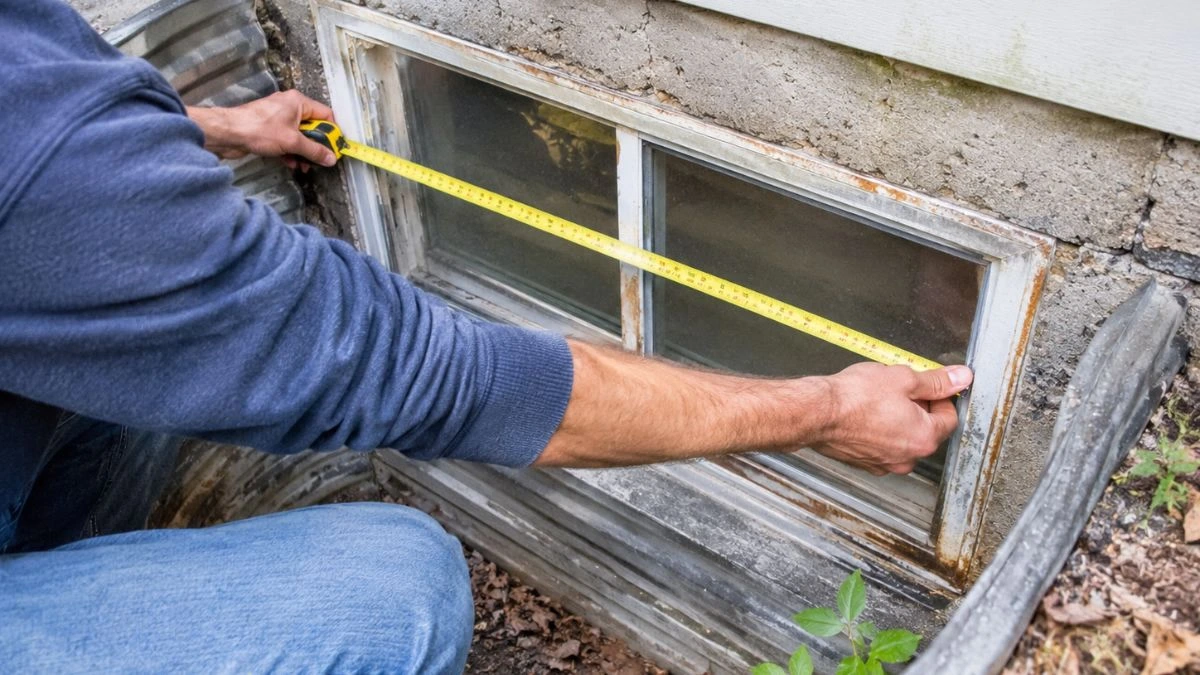
A wrong measurement by even half an inch means your new window won’t fit — and returning a custom-ordered unit from a manufacturer like JELD-WEN can cost $150 or more in restocking fees alone.
Most homeowners measure the visible glass or the outside frame, not the rough opening — and that single mistake drives the majority of incorrect orders.
Follow this guide and you’ll know exactly where to measure, which numbers to record, and how to order a replacement window that fits correctly the first time.
What Tools and Setup Do You Need Before Measuring?
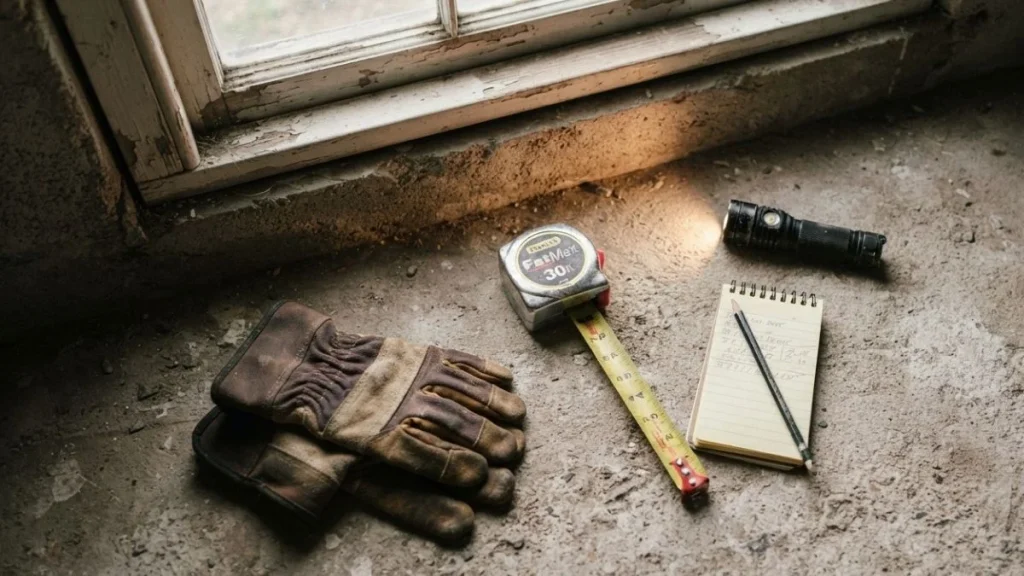
You need 4 basic tools to measure basement windows accurately. No special equipment is required for standard replacements.
The Essential Tool List
- 25-foot tape measure — a rigid steel tape, not a fabric one, for accurate inside-to-inside measurements across the window opening
- Notepad and pencil — record every measurement immediately; don’t rely on memory
- Flashlight — basement window openings are often poorly lit, especially near the sill and jamb (the vertical side frames)
- Safety gloves — older metal frame windows often have sharp edges along the frame lip
A laser measure is worth using if your rough opening — the framed hole in the foundation wall — appears uneven or out of square. Brands like Bosch and DeWalt make models under $50 that confirm width and height in seconds.
Safety Checks Before You Start
Inspect the window well — the recessed area outside a basement window — before leaning in to measure. Debris, standing water, or rotted framing near the sill can shift measurements and create a safety hazard.
If you’re replacing a basement egress window (a code-required emergency exit window), check the window well dimensions too. International Residential Code requires egress windows to have a minimum 9-square-foot well area with at least 36 inches of width and depth. Measuring only the window frame and ignoring the well is a common and costly oversight.
Check the existing frame for rust, rot, or warping before recording any numbers. A damaged jamb or sill gives false measurements that won’t reflect the true rough opening size.
How Do You Measure Width and Height Correctly?
Measure the rough opening — not the existing window frame — at 3 points for both width and height. This catches uneven concrete or shifted jambs before they cause a misfit.
Measuring Width: Three Points, One Number
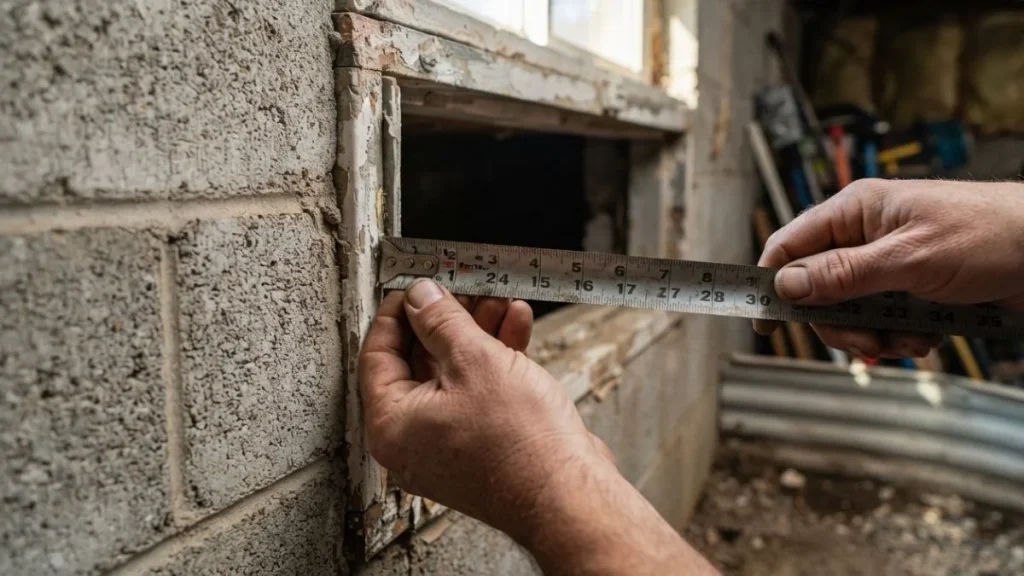
Place your tape measure inside the opening, from the left jamb surface to the right jamb surface. Take 3 horizontal measurements:
- Across the top of the opening
- Across the middle of the opening
- Across the bottom, just above the sill
Record all 3 numbers. Use the smallest measurement as your order width. This ensures the replacement window slides into the narrowest point of the opening without binding against the jamb or frame.
A typical standard basement window rough opening runs 32 inches wide, but concrete block foundations shift over decades. Don’t assume symmetry.
Measuring Height: Same Method, Same Rule
Run your tape measure vertically inside the opening — from the top of the rough opening down to the sill surface. Take 3 vertical measurements:
- Along the left jamb
- Down the center
- Along the right jamb
Again, record all 3 and order using the smallest number. A standard basement window height is commonly 15 or 16 inches, but poured concrete walls frequently taper or slope at the sill, making left-side and right-side measurements differ by a quarter inch or more.
Handling Non-Square Openings
If your 3 width measurements vary by more than half an inch, the opening is out of square. In that case, note the exact measurements for each point and contact the window manufacturer — companies like Andersen Windows or JELD-WEN can cut custom metal frame window dimensions to fit non-rectangular rough openings.
Inside Frame vs. Outside Frame: What’s the Critical Distinction?
Measuring the wrong surface is the single most common reason replacement windows arrive in the wrong size. For a direct replacement, you need the inside-to-inside measurement — the clear opening between the interior faces of the jambs and sill, not the outer edges of the frame.
What “Inside Measurement” Actually Means
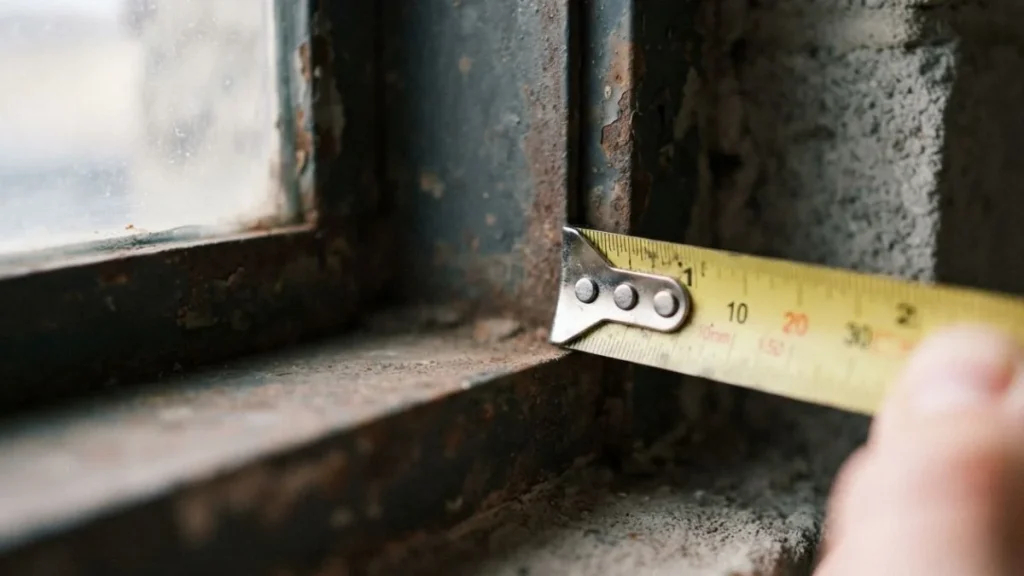
The inside measurement runs from the interior face of one jamb to the interior face of the opposite jamb. On a metal frame window — the type most common in basement installations — the frame lip overlaps the concrete edge by roughly half an inch on each side. If you measure across the outside of that metal frame, you add a full inch to your actual opening size and order a window that physically cannot fit.
Run your tape measure tip to the flat inner wall surface of the jamb, not the outer lip. Do the same top to bottom, landing on the sill surface itself rather than any existing frame flange.
When Outside-Frame Measurement Matters
Outside-frame dimensions matter only when a contractor is cutting or enlarging a rough opening — the full framed hole in the foundation wall. In that scenario, the rough opening measurement tells the contractor how much concrete or framing to remove.
For a standard homeowner replacement where the rough opening stays unchanged, the outside measurement creates confusion and ordering errors. Stick to inside-to-inside.
Identifying the Jamb Edges on Metal Frames
On older basement metal frame windows, the jamb edge isn’t always obvious. Look for the point where the frame transitions from the visible face to the embedded flange that sits inside the wall. That transition line is your measurement boundary. If paint or caulk has built up along the jamb, scrape it back before measuring — even a quarter inch of buildup affects metal frame window dimensions enough to cause a misfit on a tight rough opening.
How Do Egress and Standard Window Measurements Differ?
Standard basement window replacement is a straight swap — same rough opening, same size window. Egress window replacement follows building code minimums that dictate the clear opening size, and those requirements add a separate set of measurements to your checklist.
Minimum Clear Opening for Egress Windows
The International Residential Code (IRC) sets 4 specific minimums for basement egress windows:
- Minimum opening height: 24 inches
- Minimum opening width: 20 inches
- Minimum net clear opening area: 5.7 square feet
- Maximum sill height from floor: 44 inches
These measurements refer to the clear opening — the usable space when the window is fully open — not the rough opening or frame size. A window can have a large rough opening and still fail egress requirements if the operable sash (the movable panel) doesn’t meet the 5.7 square foot minimum.
Window Well vs. Window Opening: Two Separate Measurements
The window well and the window opening are distinct and both require measurement in a basement egress window replacement. The window opening sits inside the foundation wall. The window well is the excavated outdoor enclosure that allows light and emergency exit access.
IRC requires the window well to provide at least 9 square feet of clear area, with a minimum of 36 inches in both width and depth. Measure the well from the foundation wall outward to the well’s front edge, then measure side to side.
Standard Basement Window Depth
Standard basement window depth — the wall thickness the window must span — is typically 8 to 11 inches for concrete block foundations. Most replacement windows are manufactured to fit this range, so depth is rarely a custom measurement. Confirm your wall thickness once with a tape measure at the sill, then verify it matches the window manufacturer’s specified installation depth before ordering.
Frequently Asked Questions
Why Measure Width at 3 Points Instead of One?
Basement window openings in concrete or block foundations shift and settle over time, making the opening wider at the top than the bottom, or vice versa. A single measurement misses this variation and risks ordering a window that binds at the narrowest point.
What If My Top, Middle, and Bottom Measurements Differ?
Use the smallest of the 3 measurements as your order dimension — this guarantees the window fits through the tightest point of the opening. If the measurements vary by more than half an inch, flag this to your window supplier before ordering, as the opening may need minor correction first.
Do I Measure Inside or Outside the Metal Frame?
Always measure inside the metal frame, from the interior face of one jamb to the interior face of the opposite jamb. Measuring the outside of the frame adds the frame lip width to your dimensions — typically half an inch per side — and produces an order size roughly one full inch too large.
Does Window Depth Need to Be Measured?
Standard replacement windows are manufactured to fit basement wall depths of 8 to 11 inches, so depth rarely requires a custom order. Measure your wall thickness once at the sill to confirm it falls within that range, then verify against the manufacturer’s specs before purchasing.
Order Confidently With Your Measurements
The difference between a window that fits and one that doesn’t comes down to one rule: always use the smallest inside-to-inside measurement from your 3-point check, never the outside frame dimension. Before submitting your order, photograph the rough opening with a tape measure visible at all 3 width points and 3 height points — those images are your proof of record if a sizing dispute arises with the supplier.